

Quick answer
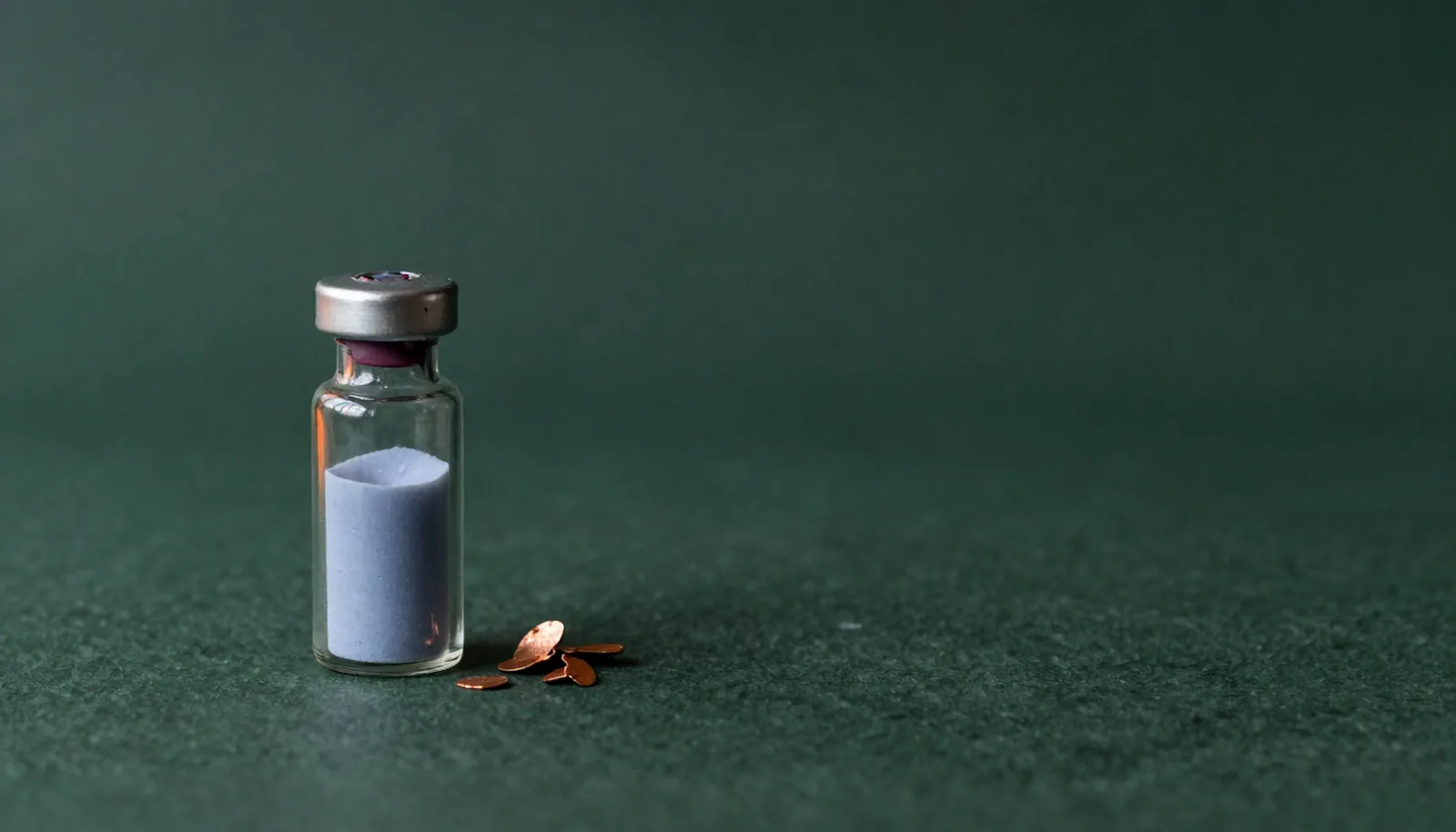
GHK-Cu is a copper(II) complex of glycyl-L-histidyl-L-lysine, a peptide of three amino acids first reported in human blood in 1973. Researchers study it in cell, animal and small skin-cream trials. It’s sold as a cosmetic ingredient and as lyophilized research material. In Canada, it isn’t an authorized drug, and Health Canada has named it in advisories. [1][3][8][10]
Key facts
- GHK (glycyl-L-histidyl-L-lysine) is a tripeptide: glycine, histidine and lysine, and GHK-Cu is that peptide bound to a copper(II) ion. [1]
- PubChem lists the complex as C14H21CuN6O4- with a molecular weight of 400.90 g/mol. [4]
- A 1973 paper reported the tripeptide in human serum. [3]
- Its plasma level is reported as about 200 ng/mL at age 20 and about 80 ng/mL by age 60. [1]
- Health Canada named GHK-Cu in advisories dated April 1, 2025, August 1, 2025 and April 9, 2026. [8][9][10]
- Our GHK-Cu 100mg lot was tested at 98.87% by high-performance liquid chromatography (HPLC) at Medutest, batch WWB-CU100-4385. [13][14]
| At a glance | Summary |
|---|---|
| Full name | Glycyl-L-histidyl-L-lysine copper(II) complex, also sold as copper tripeptide-1 [1][13] |
| Sequence | Gly-His-Lys, three amino acids [1] |
| Where it occurs | Reported in human plasma, saliva and urine [1] |
| Studied in | Cells, animals and small human skin-cream trials [1][5][7] |
| Canada | Not an authorized drug; named in Health Canada advisories [8][9][10] |
| Sport | Not named in the World Anti-Doping Agency (WADA) 2026 list, which is not exhaustive [12] |
Order for your research
Shipped from West Vancouver across Canada. Every result we hold is on the lab results page.

GHK-Cu is a naturally occurring copper-binding tripeptide, glycyl-histidyl-lysine.
For laboratory research use only. Not for human or veterinary use.
What is GHK-Cu?
GHK-Cu is a short peptide carrying a copper ion. The peptide, GHK, is glycine, histidine and lysine in a row, and when you bind copper(II) to it, you get GHK-Cu. Papers also call it a copper peptide. [1]
The 2015 review that most guides lean on says GHK “naturally occurs in human plasma, saliva, and urine.” [1] It also reports a fall in plasma level with age, from about 200 ng/mL at 20 to 80 ng/mL by 60 [1], and the authors link the fall to age, but the review doesn’t test the link. [1]
Quick facts
- Full name: glycyl-L-histidyl-L-lysine, copper(II) complex [1]
- Sequence: Gly-His-Lys [1]
- Formula: C14H21CuN6O4- (PubChem writes the complex as a singly charged anion) [4]
- Molecular weight: 400.90 g/mol [4]
- PubChem: compound 139035031 [4]
- Chemical Abstracts Service (CAS) number: not given here. Different references print different numbers for the copper complex, so match the number on a certificate to the compound it names.
Where does GHK-Cu come from?
GHK-Cu was found in blood. Loren Pickart and M. M. Thaler reported a tripeptide in human serum in 1973, and it prolonged the survival of normal liver cells in culture. [3]
Pickart’s later review describes the finding as “an activity in human albumin that caused old human liver tissue to synthesize proteins like younger tissue.” [1]
Pickart is also the lead author of the 2015 and 2018 reviews we cite [1][2], and that’s useful history, but it means much of the review literature comes from one group. So we also cite independent trials. [5][6][7]
What is the structure of GHK-Cu?
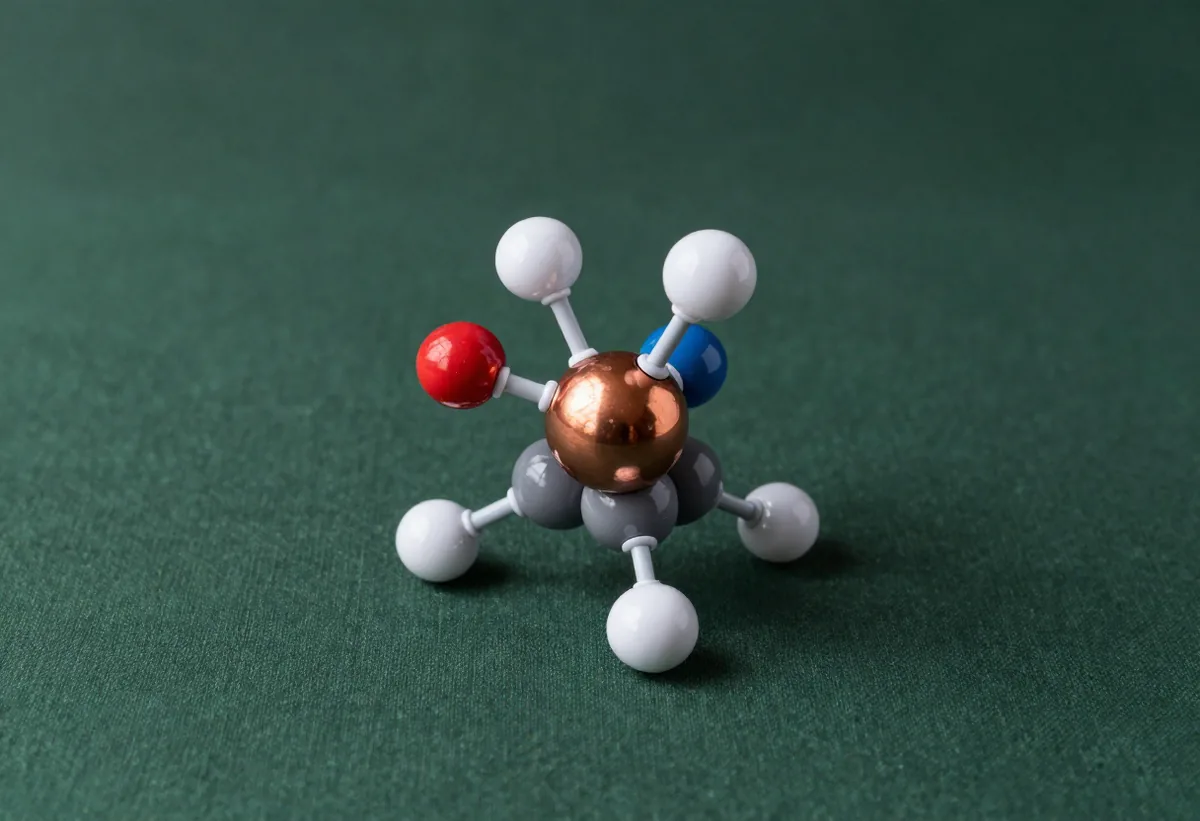
GHK-Cu’s structure is a peptide of three residues, with the copper held by three of its nitrogen atoms. The 2015 review names a histidine imidazole nitrogen, the glycine amino nitrogen and a deprotonated amide nitrogen. [1]
The same review reports that GHK holds copper(II) slightly more tightly than albumin’s copper site does, and the log binding constants are 16.44 and 16.2. [1]
It’s a small molecule by peptide standards: the PubChem record gives a formula of C14H21CuN6O4- and a weight of 400.90 g/mol. [4] Because it’s a metal complex, you’ll see the formula written in more than one way, so check which form a certificate uses. [4]
How does GHK-Cu work in studies?
No single receptor has been established. The 2015 review says the exact mechanism “is yet to be elucidated.” [1] What the studies measured is easier to list than to explain:
- Collagen and matrix: in cultured cells, GHK “stimulated both synthesis and breakdown of collagen and glycosaminoglycans,” and it also changed the activity of matrix metalloproteinases and their inhibitors, TIMP-1 and TIMP-2. The review also lists collagen synthesis in fibroblast cultures, and it notes that the GHK sequence is rare in human proteins but more common in proteins of the extracellular matrix. [1]
- Cell signals: the review reports higher vascular endothelial growth factor (VEGF) and basic fibroblast growth factor (FGF) release by stem cells in a gel, and it also reports effects on stem cell markers in skin cells. [1]
- Gene expression studies: the authors say GHK can raise or lower at least 4,000 human genes, but that figure comes from computer comparisons of gene signatures, not a trial. [1]
- Other pathways: the 2018 review adds NF-kB, DNA repair genes and protein clearance. [2]
All of this describes cells and databases. It isn’t a statement about what GHK-Cu does in a person, and we don’t make one.
Why does GHK-Cu carry copper?
The copper is what makes it GHK-Cu. The 2015 review calls copper binding “the most distinctive feature of GHK,” and it’s the reason purity needs a second look. [1]
Its authors also say the binding silences copper’s redox activity, so the complex can carry copper into cells without the toxicity of free copper [1], but that’s a claim in a review, not a result it demonstrates.
The copper changes how you read a purity figure: an HPLC result tells you how much of the sample is one peptide peak. On a copper complex, peptide purity and copper content are separate questions, and HPLC addresses the peptide. [13] It doesn’t by itself say how much copper is bound.
Our product page says this plainly, and it also says the assay doesn’t measure sterility, endotoxin or heavy metals [13], and if a seller shows one purity number for a metal complex and says nothing else, ask what the number covers.
GHK-Cu in cosmetics vs research vials
Cosmetic copper tripeptide-1 and a GHK-Cu research vial differ in form, human data and status in Canada. Most human data on GHK-Cu come from cosmetic creams, and a cream trial doesn’t describe a research vial. [1][7]
| Feature | Cosmetic ingredient | Research vial |
|---|---|---|
| Common name | Copper tripeptide-1 in creams [13] | GHK-Cu, lyophilized powder [13] |
| Form | Finished skin product | Freeze-dried peptide for laboratory work |
| Human studies | Small cream trials, such as 12 weeks in 71 women [1] | None for the vial itself |
| Canada | Cosmetic products are outside this guide | Not an authorized drug [8][10] |
We don’t give use advice for either one. This guide covers the compound, and our products are for laboratory research only. For the wider group of peptides studied in tissue repair models, see our healing peptides guide.
What does the research on GHK-Cu show?
The research on GHK-Cu is mostly cell and animal work with a thin human record, and a 2026 systematic review of 64 records called the human literature “thin and fragmented.” Most randomized trials of topical GHK-Cu it found were small and used facial cosmetic creams. [7]
| Evidence level | What was measured | Example | Source |
|---|---|---|---|
| Cells | Collagen, matrix enzymes, growth factor release | Skin and stem cells in culture | [1] |
| Animals | Wound healing and tissue repair | Rabbits, rats, mice and pigs, as summarized by the 2015 review | [1] |
| Animals, one study | Knee ligament graft repair | In rats, knee looseness differed at 6 weeks but not at 12 weeks | [6] |
| Humans, cream | Skin measures | A 12-week facial cream in 71 women; a one-month thigh cream with skin biopsies | [1] |
| Humans, controlled | Healing after laser resurfacing | 13 patients; no objective difference, higher satisfaction scores (P = .04) | [5] |
The two controlled studies we opened both argue for caution: the rat study’s title says the effect was transient [6], and in the 13-patient trial, blinded evaluators found no significant difference in redness or wrinkles. [5]
What do those results mean? Mostly that the question is open. They don’t show that GHK-Cu treats, prevents or improves any condition, and nothing here claims it does.

What does Health Canada say about GHK-Cu?
Health Canada says “peptides are generally regulated as prescription drugs” in Canada, and no authorized product lists GHK-Cu. [10][11] Here are the dated facts.
Status checked 12 Nov 2026
- Drug Product Database: a search of Health Canada’s database on November 12, 2026 returned no product for the ingredient names “ghk,” “glycyl” or “tripeptide.” [11]
- Health Canada advisories: the April 1, 2025 advisory lists “GHK-Cu without Mannitol” among seized products. The August 1, 2025 advisory lists “GHK, GHK-Cu,” and the April 9, 2026 advisory lists GHK-Cu among affected products. [8][9][10]
- Research labels: Health Canada says “For Research Use Only” labelling “does not make these products legal or exempt from regulatory requirements.” [10]
- US Food and Drug Administration (FDA): its compounding safety page lists GHK-Cu among bulk substances whose nominations were withdrawn. It says there are “limited data in humans to inform safety-related considerations.” The page was current as of April 22, 2026. [12]
- WADA: the 2026 Prohibited List doesn’t name GHK-Cu. Its growth factor section says “including, but not limited to,” so a missing name isn’t a clearance. [15]
This applies to us. Our research use disclaimer says nothing on our site is authorized for sale as a drug in Canada. No product carries a Drug Identification Number. [16] For the wider legal picture, read are peptides legal in Canada.
What should a GHK-Cu certificate of analysis show?
A GHK-Cu certificate of analysis should show four things: identity, purity, assay against the label, and a batch number you can match to your vial. Because HPLC on metal complexes can’t speak to copper, add copper content for a copper complex. [13] Our guide to reading a peptide certificate of analysis (COA) covers each line.
Our GHK-Cu result
- Purity: 98.87% by HPLC. [13][14]
- Laboratory: Medutest, report MT-26684, issued February 3, 2026. [14]
- Batch: WWB-CU100-4385. [13][14]
- What it doesn’t cover: sterility, endotoxin and heavy metals. We publish a purity figure, not a copper content figure. [13]
- A related caution: the certificate for KLOW (our blend that includes GHK-Cu) carries GHK-Cu’s identity fields, so we don’t claim the blend was assayed as a blend. [14]
How is GHK-Cu stored?
Store sealed vials the way the certificate or supplier datasheet says, and our product page notes that material once it’s dissolved has a much shorter usable life than sealed powder. [13]
Buying GHK-Cu for research in Canada
Boreal Peptides is a Canadian research peptide store. Here’s the listing, checked on November 12, 2026. [13]
- Product: GHK-Cu 100mg, a lyophilized research vial.
- Price: $75 CAD.
- Test result: 98.87% by HPLC, Medutest, batch WWB-CU100-4385.
- Stock: in stock on the day we checked.
- Shipping: orders leave West Vancouver within 1 to 2 business days and arrive in 2 to 4 business days. Shipping is free at $299 or more, and the batch reference is on the packing slip. [17]
GHK-Cu is also an ingredient in KLOW and GLOW (our two blends that include it), but both were out of stock on November 12, 2026, so the single GHK-Cu 100mg vial above is the one we can ship now. Every order is placed under the research use terms above, and the compound isn’t for human or veterinary use. [13][16]
Ready to order?
Shipped from West Vancouver across Canada. Every result we hold is on the lab results page.
GHK-Cu is a naturally occurring copper-binding tripeptide, glycyl-histidyl-lysine.
For laboratory research use only. Not for human or veterinary use.
People also ask
What is GHK-Cu?
GHK-Cu is a copper(II) complex of the three-amino-acid peptide glycyl-L-histidyl-L-lysine. It’s reported in human plasma and studied in cell, animal and small skin-cream trials. [1][3]
Read more: What is GHK-Cu?
Is GHK-Cu the same as a copper peptide?
Yes, usually. “Copper peptide” most often means GHK-Cu. Other copper peptide complexes exist, and some trials used mixtures, so check the sequence on the label. [1]
Read more: Why does GHK-Cu carry copper?
What does GHK-Cu do in studies?
Studies measured collagen and matrix enzyme activity, growth factor release and gene expression in cells, plus wound repair in animals. Human data are small and mostly come from cosmetic creams. [1][7]
Read more: What does the research on GHK-Cu show?
Where does GHK-Cu come from?
GHK-Cu was reported in human serum in 1973 by Loren Pickart and M. M. Thaler. It’s also reported in plasma, saliva and urine. [1][3]
Read more: Where does GHK-Cu come from?
Does Health Canada name GHK-Cu as an unauthorized peptide?
Yes. Health Canada has named GHK-Cu in advisories on unauthorized peptide drugs, and it says research-use labels don’t make a product legal or exempt from regulatory requirements. [8][9][10]
Read more: What does Health Canada say about GHK-Cu?
Why does a purity figure read differently on a copper complex?
HPLC measures how much of a sample is one peptide peak. Copper content is a separate question, so one purity number doesn’t describe the whole complex. [13]
Read more: Why does GHK-Cu carry copper?
Sources and methodology
This guide draws on peer-reviewed papers, Health Canada advisories and its Drug Product Database (searched November 12, 2026). It also uses the US FDA, the WADA 2026 Prohibited List and our own testing records. Claims link to the numbered sources below.
How this guide was made: we researched and drafted it with AI assistance. We then checked every claim against its cited source, and the owner of Boreal Peptides reviewed it before publication.
Last reviewed: November 12, 2026. Next review: January 2027, when WADA’s 2027 list takes effect, or sooner if Health Canada or the FDA changes GHK-Cu’s status. Read our editorial policy.
Research use only
For laboratory research use only. Not for human or veterinary use. Nothing here is medical advice. Boreal Peptides supplies compounds to laboratory researchers. Read our research use disclaimer.
Sources
- Pickart L, Vasquez-Soltero JM, Margolina A. GHK peptide as a natural modulator of multiple cellular pathways in skin regeneration. BioMed Research International, 2015. doi:10.1155/2015/648108. https://pmc.ncbi.nlm.nih.gov/articles/PMC4508379/
- Pickart L, Margolina A. Regenerative and protective actions of the GHK-Cu peptide in the light of the new gene data. International Journal of Molecular Sciences, 2018. doi:10.3390/ijms19071987. https://europepmc.org/article/MED/29986520
- Pickart L, Thaler MM. Tripeptide in human serum which prolongs survival of normal liver cells and stimulates growth in neoplastic liver. Nature New Biology, 1973. PMID 4349963. https://europepmc.org/article/MED/4349963
- National Center for Biotechnology Information. PubChem compound summary, CID 139035031 (GHK-Cu). Checked November 12, 2026. https://pubchem.ncbi.nlm.nih.gov/compound/139035031
- Miller TR, Wagner JD, Baack BR, Eisbach KJ. Effects of topical copper tripeptide complex on CO2 laser-resurfaced skin. Archives of Facial Plastic Surgery, 2006. doi:10.1001/archfaci.8.4.252. https://europepmc.org/article/MED/16847171
- Fu SC, Cheuk YC, Chiu WY, Yung SH, Rolf CG, Chan KM. Tripeptide-copper complex GHK-Cu (II) transiently improved healing outcome in a rat model of ACL reconstruction. Journal of Orthopaedic Research, 2015. doi:10.1002/jor.22831. https://europepmc.org/article/MED/25731775
- Najafi N, Maatouk H, Vardanyan KG, Vartanian KB, Agrawal DK. A systematic review of the mechanisms and therapeutic applications of GHK-Cu in topical microneedle delivery: a case for expanded clinical trials. Archives of Internal Medicine Research, 2026. doi:10.26502/aimr.0255. https://europepmc.org/article/MED/42787770
- Health Canada. Unauthorized injectable peptide drugs seized at Optimum Wellness Centre, Calgary, Alberta. Public advisory, April 1, 2025. https://recalls-rappels.canada.ca/en/alert-recall/unauthorized-injectable-peptide-drugs-seized-optimum-wellness-centre-calgary-alberta
- Health Canada. Unauthorized injectable peptide drugs seized and sold by Canada Peptide may pose serious health risks. Public advisory, August 1, 2025. https://recalls-rappels.canada.ca/en/alert-recall/unauthorized-injectable-peptide-drugs-seized-and-sold-canada-peptide-may-pose-serious
- Health Canada. Think twice before injecting peptides bought online: unauthorized products can seriously harm your health. Public advisory RA-81874, April 9, 2026. https://recalls-rappels.canada.ca/en/alert-recall/think-twice-injecting-peptides-bought-online-unauthorized-products-can-seriously-harm
- Health Canada. Drug Product Database, active ingredient search by name (API), checked November 12, 2026. https://health-products.canada.ca/dpd-bdpp/
- US Food and Drug Administration. Certain bulk drug substances for use in compounding that may present significant safety risks (content current as of April 22, 2026). https://www.fda.gov/drugs/human-drug-compounding/certain-bulk-drug-substances-use-compounding-may-present-significant-safety-risks
- Boreal Peptides. GHK-Cu (Copper Peptide) 100mg product page (checked November 12, 2026). https://borealpeptides.com/ghk-cu/
- Boreal Peptides. Lab results (checked November 12, 2026). https://borealpeptides.com/lab-results/
- World Anti-Doping Agency. The 2026 Prohibited List, section S2 (in force January 1, 2026). https://www.wada-ama.org/en/prohibited-list
- Boreal Peptides. Research use disclaimer (checked November 12, 2026). https://borealpeptides.com/research-use-disclaimer/
- Boreal Peptides. Shipping and delivery, checked November 12, 2026. https://borealpeptides.com/shipping-and-delivery/