
Cognitive & Nootropic Research Peptides
Nootropic peptides are short chains of amino acids that research groups study for effects on the central nervous system. Within the wider nootropics category they sit apart from the oral compounds: they aren’t a licensed drug class, they aren’t dietary supplements, and in Canada none of them is approved for human use.
Two of the three came out of Soviet research programmes, and much of the Semax and Selank literature is still published in Russian. Cerebrolysin’s record runs the other way, through European clinical trials. That split is worth knowing before anything else.
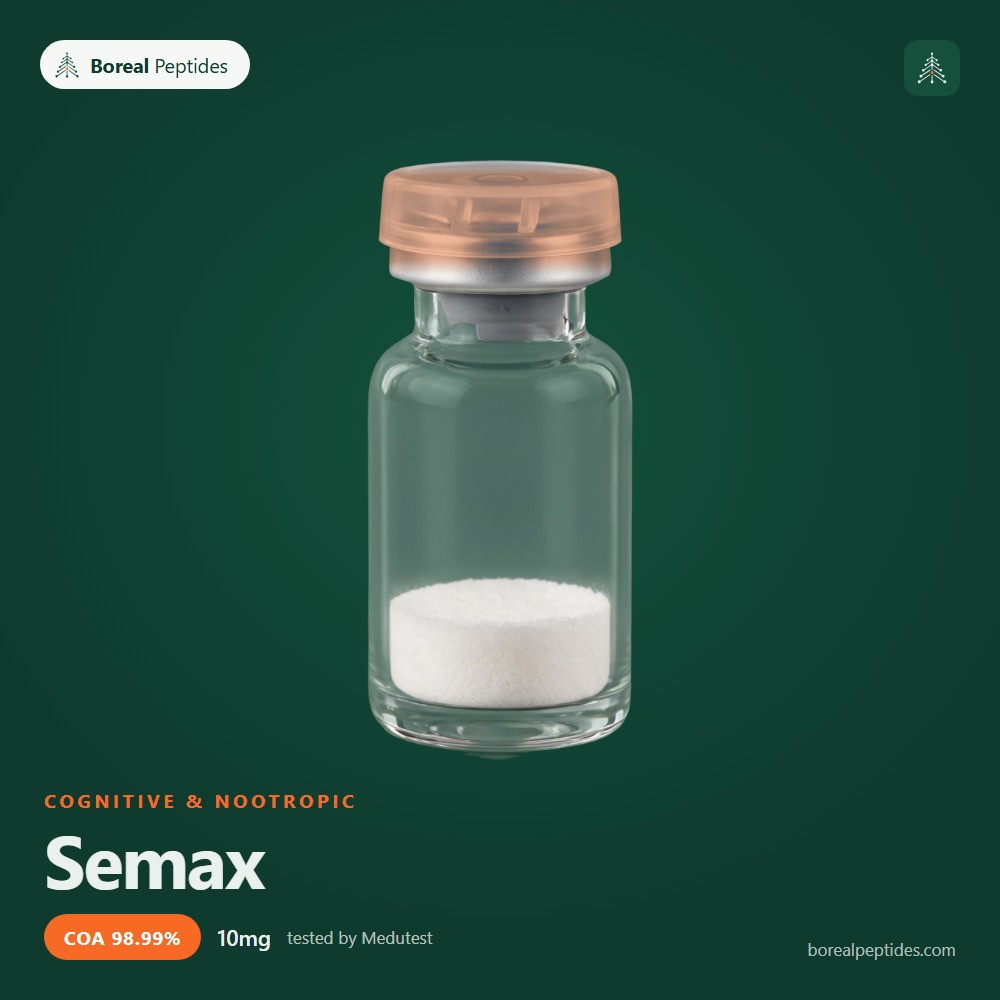
We list three. One carries a third-party purity result with the laboratory and the batch named. The other two say “not yet tested”, in those words, on their own pages.
Showing all 3 results
The nootropic peptides we hold, and what has been tested
| Compound | Identity | Purity | Laboratory | Batch |
|---|---|---|---|---|
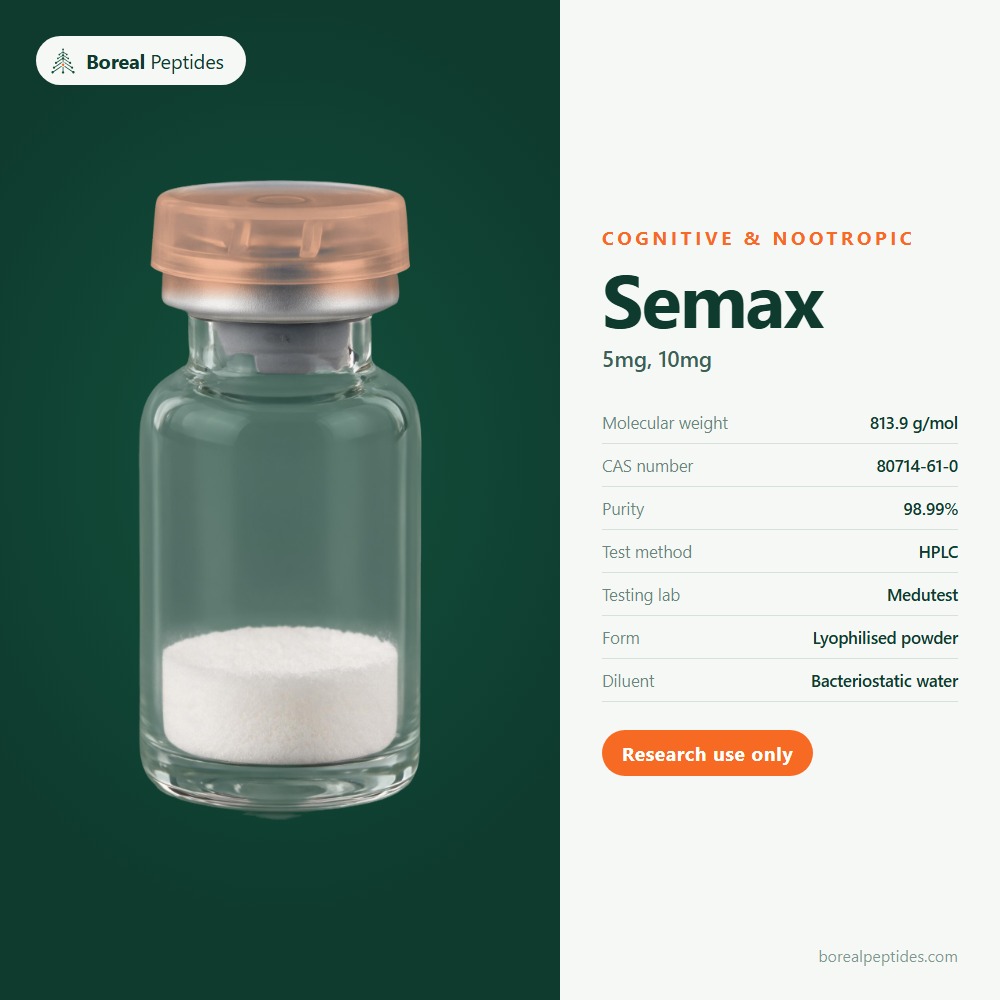
| Semax | CAS 80714-61-0, 813.9 g/mol, C37H51N9O10S | 98.59% | Medutest | WWB-XA10-2430 |
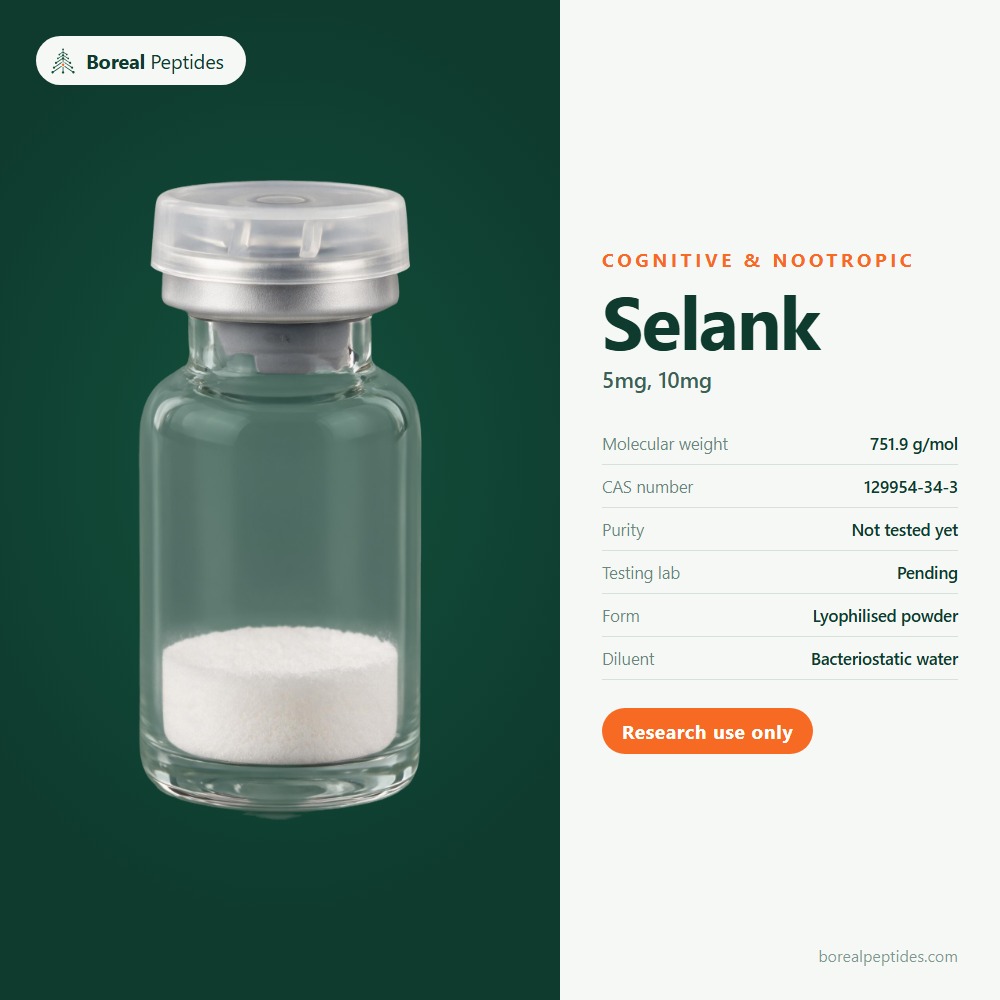
| Selank | Heptapeptide Thr-Lys-Pro-Arg-Pro-Gly-Pro, CAS 129954-34-3, 751.9 g/mol | Not yet tested | Pending | Pending |
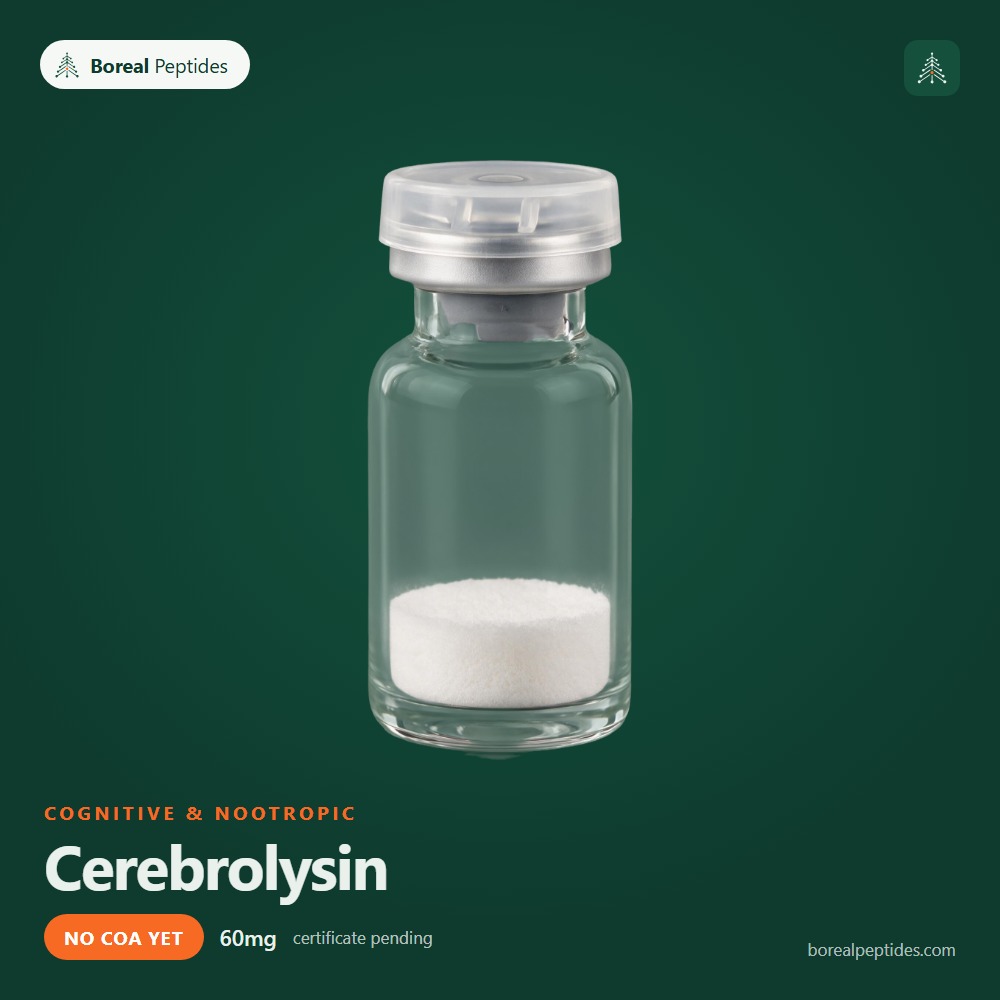
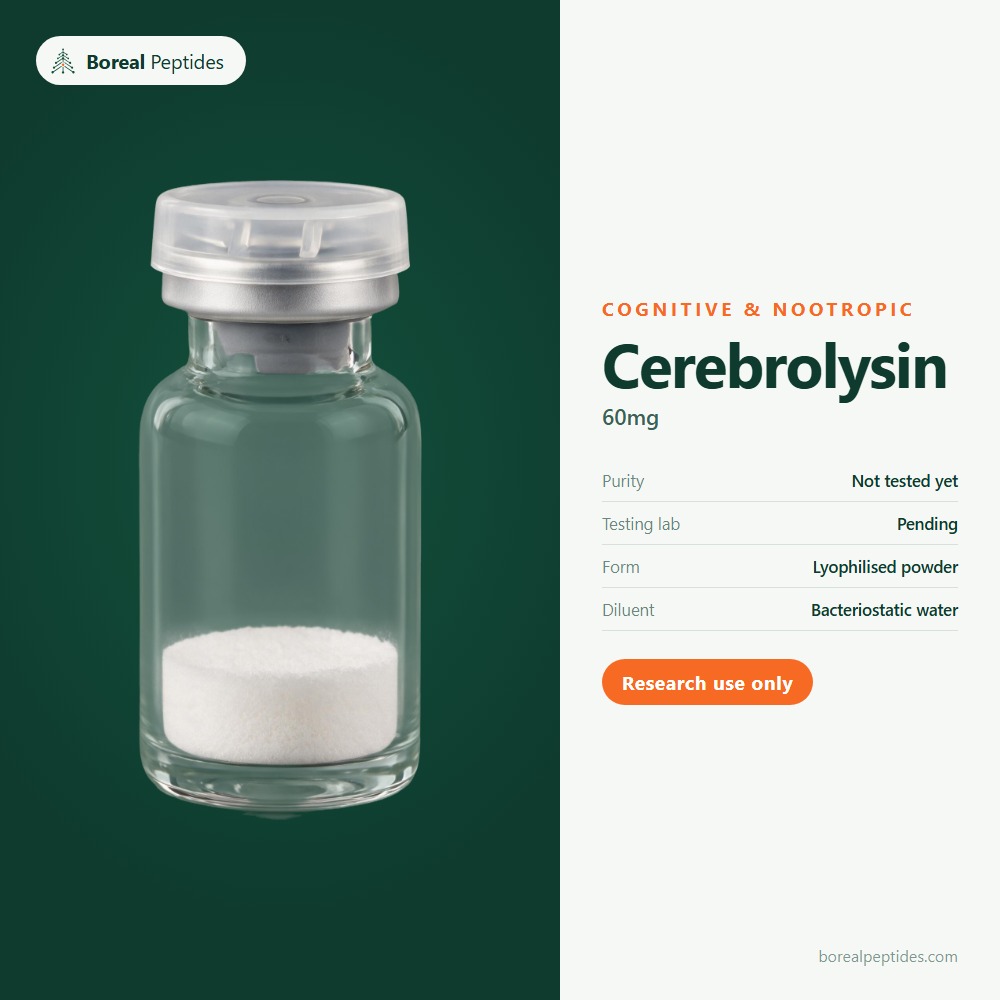
| Cerebrolysin | Porcine brain protein hydrolysate, not a single compound | Not yet tested | Pending | Pending |
One of the three carries a third-party purity result. The other two say "not yet tested" on their product pages, in those words, because that's the true state and you should be able to see it before you decide rather than after.
The Semax figure came from HPLC. An HPLC purity result covers identity and purity of the material in the tested lot. It does not measure sterility, endotoxin or heavy metals, and it describes that lot rather than everything sharing a label. We hold the report and can send it on request.
What the research on these nootropic peptides actually says
There's published research behind all three, and the honest summary is that it's thinner than the marketing around this category suggests. What matters is what each study actually measured.
Semax has been studied in animal models. A 2020 transcriptome study in rats examined gene expression after cerebral ischaemia and reperfusion, which is a neuroprotection model rather than a study of cognition in healthy people.1 Read it as what it is.
Selank is a heptapeptide, Thr-Lys-Pro-Arg-Pro-Gly-Pro, and the literature describes it as an analogue of tuftsin.2 Its last three residues, Pro-Gly-Pro, are the same tail Semax carries, since Semax is the ACTH(4-7) fragment with Pro-Gly-Pro attached.1 That shared tail is the real reason these two get grouped together, more than the shared country of origin. The published Selank work is animal work: a 2022 study measured behavioural signs of morphine withdrawal in rats.3 There's no human trial here we're prepared to stand behind.
Cerebrolysin isn't a synthesised peptide at all. It's a preparation made by standardised enzymatic breakdown of porcine brain proteins, described in a Cochrane review as roughly 80% low molecular weight peptides and 20% free amino acids.4 If animal-derived material matters to you, that's the fact on this page you most need before deciding.
It's also the only one here with human clinical trials behind it, and that comes with one important qualification. The CARS trial was a randomised, placebo-controlled, double-blind multicentre study in stroke recovery.5 That trial tested the licensed pharmaceutical preparation made by its manufacturer. It was not testing a research-grade vial bought online, and the two are not interchangeable. Anyone citing CARS to describe a research compound is stretching it well past what the trial supports.
Where mechanisms are discussed at all, the literature measures neurotrophic factor expression, brain-derived neurotrophic factor (BDNF) and nerve growth factor (NGF) among them, along with markers of synaptic plasticity and the neurotransmitters involved. Those are the outcomes the published studies report in their own models. They are not outcomes we're claiming for anything sold here.
Semax and Selank also turn up in longevity and nootropics discussion online, often under labels like peptide bioregulators or neuroprotective peptides. That discussion is not evidence, and we've kept it out of the descriptions on this site. The compounds we actually group under ageing and cellular work sit in longevity and cellular research peptides, the neighbouring category to this one.
Regulatory status in Canada
Health Canada regulates injectable peptides as drugs and has stated in writing that labelling one "for research use only" does not remove it from that regulation.6 Semax appears by name on the seizure list in one of those notices.7 Every compound on this page is supplied for laboratory research use only, and nothing here is approved for human or veterinary use.
These are not peptide therapy products. Nothing in this category is supplied for therapy, and we publish no dosing, no protocols and no stacks. Research use labelling is often presented as though it settles the legal question. On the regulator's own published statements, it doesn't.
Buying nootropic peptides in Canada
These ship as single lyophilised vials, anywhere in Canada. Semax comes in 5mg and 10mg, Selank in 5mg and 10mg, and Cerebrolysin as a single 60mg vial, each reconstituted with bacteriostatic water.
Price and current availability sit on each product page. Where a compound can't be ordered yet, its page carries no price rather than a placeholder, so what you see there is the real state rather than a promise we can't keep today.
Compare nootropic peptides on price per milligram rather than price per vial, because strengths differ between suppliers and a cheaper vial is often a smaller one. When you order, the batch reference travels on the packing slip, so the report you read on a product page is the report for the vial you open.
Browse the full range, or contact us with a compound name to ask for a certificate before you buy.
Common questions
What are nootropic peptides? Short chains of amino acids joined by peptide bonds, studied for effects on the central nervous system. Both synthetics on this page are heptapeptides, seven residues each, which is tiny beside a protein, and Cerebrolysin isn't a single compound at all. They're biologically active peptides and neuroactive compounds rather than a licensed drug class, and they aren't dietary supplements. Cognitive peptides, brain peptides and peptide nootropics all name the same group, and none of those labels is a claim about cognitive enhancement or brain health.
How do nootropic peptides work? Differently in each case, and none of it is settled. The Semax study we cite read gene expression in rat brain tissue after induced ischaemia. The Selank study scored rat behaviour during morphine withdrawal. The Cerebrolysin trial measured stroke recovery in people, using the licensed pharmaceutical rather than a research vial. Three models, three questions, and no mechanism established in a healthy person. Peptide research on half-life, bioavailability and interactions is thinner still.
Are nootropic peptides safe? No safety profile has been established for any compound in this category, and a purity assay isn't a safety assessment. An HPLC result covers identity and purity in one lot. It doesn't measure sterility, endotoxin or heavy metals. There are no published safety reviews or clinical guidelines on peptide safety in this category that we would point you to, and we are not going to invent one.
Are nootropic peptides legal in Canada? Health Canada regulates injectable peptides as drugs, and research use labelling doesn't change that. Semax is named in its notices. What that means in practice is that nothing here is approved for use in a person, we won't supply dosing, and buying a vial doesn't make its use lawful.
Which of these has a certificate of analysis? Semax, at 98.59% by Medutest, batch WWB-XA10-2430. Selank and Cerebrolysin aren't tested yet and their pages say so.
How long does reconstituted material last? Much less time than sealed lyophilised powder. Reconstitution shortens the usable life considerably, which is why the vials ship as dry powder rather than in solution.
Sources
- Filippenkov IB et al. "Novel Insights into the Protective Properties of ACTH(4-7)PGP (Semax) Peptide at the Transcriptome Level Following Cerebral Ischaemia-Reperfusion in Rats." Genes, 2020. doi:10.3390/genes11060681. https://pubmed.ncbi.nlm.nih.gov/32580520/
- PubChem Compound Summary, CID 11765600, Selank. Sequence Thr-Lys-Pro-Arg-Pro-Gly-Pro, formula C33H57N11O9. https://pubchem.ncbi.nlm.nih.gov/compound/11765600
- Konstantinopolsky MA et al. "Selank, a Peptide Analog of Tuftsin, Attenuates Aversive Signs of Morphine Withdrawal in Rats." Bulletin of Experimental Biology and Medicine, 2022, 173(6), 730-733. doi:10.1007/s10517-022-05624-x. https://pubmed.ncbi.nlm.nih.gov/36322304/
- Cui S, Chen N, Yang M, Guo J, Zhou M, Zhu C, He L. "Cerebrolysin for vascular dementia." Cochrane Database of Systematic Reviews, 2019, CD008900. doi:10.1002/14651858.CD008900.pub3. https://pmc.ncbi.nlm.nih.gov/articles/PMC6844361/
- Muresanu DF et al. "Cerebrolysin and Recovery After Stroke (CARS): A Randomized, Placebo-Controlled, Double-Blind, Multicenter Trial." Stroke, 2016. doi:10.1161/strokeaha.115.009416. https://pubmed.ncbi.nlm.nih.gov/26564102/
- Health Canada. "Think twice before injecting peptides bought online: unauthorized products can seriously harm your health." Advisory, 9 April 2026: "This type of labelling does not make these products legal or exempt from regulatory requirements." https://recalls-rappels.canada.ca/en/alert-recall/think-twice-injecting-peptides-bought-online-unauthorized-products-can-seriously-harm
- Health Canada. "Unauthorized injectable peptide drugs seized and sold by Canada Peptide may pose serious health risks." Semax appears on the seized-product list. https://recalls-rappels.canada.ca/en/alert-recall/unauthorized-injectable-peptide-drugs-seized-and-sold-canada-peptide-may-pose-serious