

Quick answer
In KLOW (80 mg) vs GLOW (70 mg), the two research blends share BPC-157, TB-500 and GHK-Cu, and KLOW adds a fourth compound, KPV (Lys-Pro-Val). On our labels, GHK-Cu makes up 50 mg of each. Neither has a finished-blend assay, and both were out of stock on November 12, 2026. [1][2]
Key facts
- Both blends hold BPC-157 10 mg, TB-500 10 mg and GHK-Cu 50 mg, but only KLOW also holds KPV 10 mg. [1][2]
- GHK-Cu is 62.5% of KLOW by weight and 71.4% of GLOW, and neither blend is an even split. [1][2]
- KLOW’s certificate (Medutest MT-12327) reports 99.63%, but its identity data describes GHK-Cu only. [1][3]
- GLOW has no certificate yet, so it carries no purity claim. [2][4]
- Health Canada’s April 9, 2026 advisory names BPC-157, GHK-Cu, KPV and TB-500. [5]
| At a glance | KLOW | GLOW |
|---|---|---|
| Compounds | BPC-157, TB-500, GHK-Cu, KPV | BPC-157, TB-500, GHK-Cu [1][2] |
| BPC-157 | 10 mg | 10 mg [1][2] |
| TB-500 | 10 mg | 10 mg [1][2] |
| GHK-Cu | 50 mg | 50 mg [1][2] |
| KPV | 10 mg | None [1][2] |
| Total per vial | 80 mg | 70 mg [1][2] |
| Third-party result on file | Medutest MT-12327, 99.63% (identity data covers GHK-Cu only) | None. Finished-blend assay pending [1][2][4] |
| Listed price (CAD) | $200.00 | $139.00 [1][2] |
| Price per mg (our arithmetic) | $2.50 | $1.99 |
| Stock on November 12, 2026 | Out of stock | Out of stock [1][2] |
Order for your research
Shipped from West Vancouver across Canada. Every result we hold is on the lab results page.

BPC-157 is a synthetic pentadecapeptide, fifteen amino acids, originally isolated from human gastric juice.

TB-500 is a synthetic fragment of thymosin beta-4, corresponding to residues 17 to 23 of the parent protein.

GHK-Cu is a naturally occurring copper-binding tripeptide, glycyl-histidyl-lysine.
For laboratory research use only. Not for human or veterinary use.
KLOW vs GLOW: the short answer
KLOW holds four compounds and GLOW holds three, and the extra compound in KLOW is KPV. [1][2]
There’s a second difference, and it matters more for a researcher. KLOW has a certificate that doesn’t describe the finished blend, and GLOW has no certificate at all. We cover both below. [3][4]
Both listings said “out of stock” on November 12, 2026, and we’re saying so up front so you don’t plan around a vial that can’t ship today. The single compounds are in stock, and the buying section lists them. [1][2]
What is KLOW?
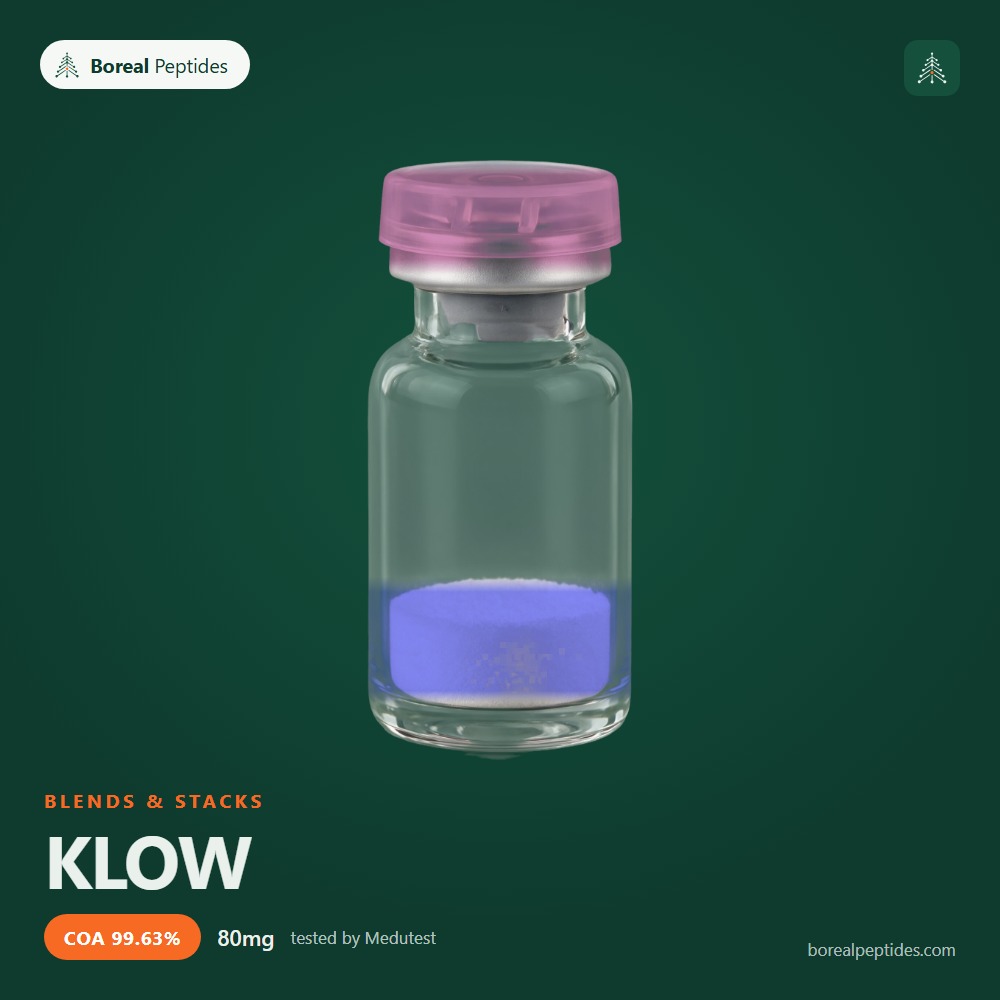
KLOW is a four-compound research blend in one 80 mg vial: TB-500 10 mg, BPC-157 10 mg, KPV 10 mg and GHK-Cu 50 mg. [1] Some sites write the name as K L O W. [1]
It’s listed at $200.00 and was out of stock on November 12, 2026. [1] The lot we hold is batch WWB-KL80-6138. [1]
You’ll find the full lot details on the KLOW product page. [1]
What is GLOW?
GLOW is a three-compound research blend in one 70 mg vial: BPC-157 10 mg, GHK-Cu 50 mg and TB-500 10 mg. [2] The copper complex gives the powder its blue colour. [2]
It’s listed at $139.00 and was out of stock on November 12, 2026. [2] Our page says it hasn’t been tested as a finished blend, so it carries no purity claim. [2]
The GLOW product page says the same, and it shows the current stock status. [2]
What is the extra compound in KLOW?
The extra compound in KLOW is KPV, and it’s a tripeptide, which means a chain of three amino acids: lysine, proline and valine. [10] Its sequence matches positions 11 to 13 of alpha-MSH, a melanocortin hormone, and PubChem lists it as “Msh (11-13)”. [10][17] It has a molecular mass of about 342.43 daltons. [10]
What did researchers measure? Two 2008 papers are the main ones, and in cell work, nanomolar concentrations of KPV reduced NF-kB and mitogen-activated protein (MAP) kinase signalling and lowered pro-inflammatory cytokine secretion. [16] In two mouse colitis models, cytokine expression fell. [16] A second group reported lower inflammatory infiltrates and lower myeloperoxidase activity in colon tissue in a mouse colitis model. [17]
Those are cell and animal results, and neither paper tested KPV inside a blend. [16][17] The US Food and Drug Administration (FDA) says it “has not identified any human exposure data on drug products containing KPV administered via any route of administration.” [7]
The single compound has its own page: KPV 10 mg, which carries a 99.44% Medutest result. [22]
What our blend certificates show
We’d publish a problem before we’d hide it, so here’s what we’ve said about both blend certificates on our own pages. [3][4]
Published testing data: Boreal Peptides
- KLOW: Medutest report MT-12327, batch WWB-KL80-6138, issued February 2, 2026, reporting 99.63% by high-performance liquid chromatography (HPLC). [1][4]
- What the identity block says: Chemical Abstracts Service (CAS) number 49557-75-7 at 403.93 Da, with a mass spectrometry line confirming a single species. [3]
- Why that’s a problem: those are GHK-Cu’s identity fields. In our FAQ’s words, “A four-compound blend cannot have one CAS number.” [3]
- GLOW: no third-party certificate, so no purity claim. [2][4]
- Where it stands: “We have asked the laboratory what was analysed. Until they answer, our blends page says so rather than claiming a finished-blend assay we cannot support.” [3]
- Method limits: an HPLC assay covers identity and purity in the tested sample. It doesn’t cover sterility, endotoxin, heavy metals, residual solvents or microbial content. [3]
Where do the numbers add up? The 99.63% figure is a real purity result for the sample the laboratory tested. [4] The mass also adds up for GHK-Cu: GHK (glycyl-L-histidyl-L-lysine) weighs 340.38 Da, and copper adds about 63.55, which gives 403.93. [11]
Where don’t they? By the mg split per label, a finished KLOW vial should show four identities, and the certificate shows one. [3] So the identity of BPC-157, TB-500 and KPV, 30 mg of the 80 mg, isn’t confirmed by that document. For GLOW, the unconfirmed share would be 20 mg of 70 mg, and there’s no document yet. [1][2]
The same FAQ says our CJC-1295 and Ipamorelin blend has the same problem. [3] It also says that the verification web addresses printed on our Medutest certificates returned identical pages for five requests, including one code we invented. [3] That’s why we name the laboratory, report number and batch, but don’t point you at a verify button.
Read our guide to how to read a peptide certificate of analysis, or see every lab result we hold. [4]
How do KLOW and GLOW differ in studies?
KLOW and GLOW differ in studies only by KPV, because we found no published study of either finished blend. A Europe PMC (PubMed Central) search for “BPC-157 TB-500 GHK-Cu blend” on November 12, 2026 returned no results, so the research is compound by compound. Here’s what each study measured, with its model and date.
| Compound | In KLOW | In GLOW | What studies measured |
|---|---|---|---|
| BPC-157 | Yes | Yes | A systematic review of studies up to June 3, 2024 found 36 studies: 35 preclinical and 1 retrospective clinical study of 12 patients. In animal models, the studies reported functional, structural and biomechanical outcomes in muscle, tendon, ligament and bone injuries. [13] |
| TB-500 (a thymosin beta-4 fragment) | Yes | Yes | In a 1999 rat wound model, thymosin beta-4 (the full protein, not the fragment) raised re-epithelialization by 42% at 4 days and up to 61% at 7 days over saline, and it also raised keratinocyte migration 2 to 3 fold in a cell assay. [14] |
| GHK-Cu | Yes | Yes | A 2018 review reports effects on collagen, elastin and glycosaminoglycan synthesis in cell work, and gene-expression data, but it’s a narrative review, not a trial. [15] |
| KPV | Yes | No | Cell work and two mouse colitis models (2008): lower inflammatory signalling and lower inflammation scores. [16][17] |
One study is closer to the blends than the rest, and it’s a 2026 rat study that tested BPC-157, TB-500 and both together after Achilles tendon transection and repair. [18] It used 32 rats in four groups of eight. [18]
The TB-500 group had a significantly higher maximum load to failure than controls at four weeks. [18] The authors wrote that combined treatment “did not confer additional benefits compared to either agent alone.” [18] They called it an exploratory study and asked for more work. [18]
So what separates the blends in the literature? Only KPV. GLOW has no component from the melanocortin line of work, and KLOW does. Everything else is shared. [1][2][16][17]
What is the status of KLOW and GLOW in Canada?
As far as we can tell, neither KLOW nor GLOW is an authorized drug in Canada. Here’s what we checked.
Status checked November 12, 2026
- Health Canada, drug database: we searched the Drug Product Database by active ingredient for BPC (the stem of BPC-157), thymosin, GHK and KPV and found no entries, but we didn’t search the natural health product database. [6]
- Health Canada, advisory: the April 9, 2026 advisory lists BPC-157, GHK-Cu, KPV and TB-500 in its list of examples of unauthorized peptide drugs. It says “For Research Use Only” labelling “does not make these products legal or exempt from regulatory requirements.” [5]
- US FDA: its compounding page (content current as of April 22, 2026) lists BPC-157, TB-500, GHK-Cu (for injectable routes) and KPV in a table of substances “nominated but withdrawn,” with safety notes. That page is about compounding, not marketing approval, and the categories have been changing, so check it again. [7]
- World Anti-Doping Agency (WADA): the 2026 Prohibited List names BPC-157 in S0 and “Thymosin-β4 and its derivatives e.g. TB-500” among growth factors in S2. GHK-Cu and KPV aren’t named, but the list says “including, but not limited to.” [8]
What does that mean for the two blends? Neither blend is an authorized drug in Canada, and a research label doesn’t change that. [5][6] Both contain BPC-157 and TB-500, so both contain substances WADA names. [8]
Our own disclaimer says the same thing, and we’d ask you to read our research use disclaimer and Are peptides legal in Canada?. [3]
How to tell them apart on a certificate of analysis
A certificate of analysis (CoA) is a laboratory report on one tested sample, and for a blend, it should show more than one identity. These are the masses to look for. [9][10][11][12]
| Compound | Mass (daltons) | In KLOW | In GLOW |
|---|---|---|---|
| BPC-157 | 1,419.5 | Yes | Yes [9] |
| TB-500 | 889.0 | Yes | Yes [12] |
| GHK-Cu | 403.93 (GHK 340.38 plus copper 63.55) | Yes | Yes [11] |
| KPV | 342.43 | Yes | No [10] |
Three checks help. Mass: a finished KLOW report should list four, and a GLOW report three. Identity: a single CAS number or a single mass means the laboratory identified one compound. Purity: in our reading, a multi-component HPLC run should separate each component into its own peak, so ask whether the percentage covers every peak or just one.
Our results are short. KLOW’s certificate shows one identity, 403.93 Da and CAS 49557-75-7, which is GHK-Cu. [3] GLOW has no certificate. [4]
Is the GHK-Cu match a surprise? Not much of one, since GHK-Cu is the largest component by weight in both vials, but it still can’t confirm the other three compounds. [1][3]
Buying them for research in Canada
Both blends are out of stock on November 12, 2026. [1][2] Boreal Peptides ships across Canada, and the batch reference travels on the packing slip. [3]
The four compounds inside the blends are in stock as single vials, and each has its own certificate. [19][20][21][22] They’re sold one compound per vial. [3]
| Single compound | Vial | Price (CAD) | Result on file | Link |
|---|---|---|---|---|
| BPC-157 | 10 mg | $60.00 | 99.781%, Janoshik, report #51140, batch GYC4CQSX (lot ID), February 21, 2026 [4][19] | View BPC-157 |
| TB-500 | 10 mg | $98.00 | 98.99%, Medutest, report MT-52854, batch WWB-BT10-7694, February 3, 2026 [4][20] | View TB-500 |
| GHK-Cu | 100 mg | $75.00 | 98.87%, Medutest, report MT-26684, batch WWB-CU100-4385, February 3, 2026 [4][21] | View GHK-Cu |
| KPV | 10 mg | $85.00 | 99.44%, Medutest, report MT-23454, batch WWB-KP10-4608, February 21, 2026 [4][22] | View KPV |
Note that the GHK-Cu single vial is 100 mg, while the blends hold 50 mg. [1][2][21] Each result above describes that single compound’s lot, not a blend. [3]
To watch for a restock, use the KLOW or GLOW product page, and for more compounds in this research area, see our healing peptides research hub.
Ready to order?
Shipped from West Vancouver across Canada. Every result we hold is on the lab results page.
BPC-157 is a synthetic pentadecapeptide, fifteen amino acids, originally isolated from human gastric juice.
TB-500 is a synthetic fragment of thymosin beta-4, corresponding to residues 17 to 23 of the parent protein.
GHK-Cu is a naturally occurring copper-binding tripeptide, glycyl-histidyl-lysine.
For laboratory research use only. Not for human or veterinary use.
People also ask
What is KLOW peptide, and what is in it?
KLOW is a research blend of four compounds in one 80 mg vial on our label: TB-500 10 mg, BPC-157 10 mg, KPV 10 mg and GHK-Cu 50 mg. [1] It’s supplied for laboratory research use only.
Read more: What is KLOW?
What is GLOW peptide?
GLOW is a research blend of three compounds in one 70 mg vial on our label: BPC-157 10 mg, GHK-Cu 50 mg and TB-500 10 mg. [2] It has no finished-blend assay yet, so it carries no purity claim.
Read more: What is GLOW?
What is the difference between KLOW and GLOW?
KLOW contains KPV and GLOW doesn’t. That makes KLOW 80 mg and GLOW 70 mg. Both hold BPC-157 10 mg, TB-500 10 mg and GHK-Cu 50 mg. [1][2] Only KLOW has a certificate, and its identity data describes GHK-Cu only. [3]
Read more: KLOW vs GLOW: the short answer
What does KLOW peptide do?
We don’t make claims about what KLOW does in people, and no study has tested the finished KLOW blend. Published work covers each compound separately: BPC-157 and TB-500 in rat tendon models, GHK-Cu in cell and gene work, and KPV in mouse colitis models. [13][15][16][18]
Read more: How do KLOW and GLOW differ in studies?
Is there a BPC-157, TB-500 and KPV blend?
No. We don’t sell a BPC-157, TB-500 and KPV blend as a separate product. KLOW holds those three compounds plus GHK-Cu at 50 mg. [1]
Read more: What is KLOW?
What is the Canadian status of KLOW and GLOW?
We found no authorized drug product containing these compounds in Health Canada’s Drug Product Database on November 12, 2026. Health Canada also says a “For Research Use Only” label doesn’t make a product legal. [5][6]
Which of KLOW and GLOW has a certificate of analysis?
Only KLOW has one: a Medutest certificate reporting 99.63%, but its identity data describes GHK-Cu only. GLOW has none. [3][4]
Read more: What our blend certificates show
Sources and methodology
We read our own product pages, FAQ and lab results register on November 12, 2026, and checked every compound claim against the sources below. Study results are reported as the authors stated them, with model and year. Where a result came from animals or cells, we say so, and we didn’t use sellers, forums or social media as sources.
How this guide was made: we researched and drafted it with AI assistance. We then checked every claim against its cited source, and the owner of Boreal Peptides reviewed it before publication.
Last reviewed: November 12, 2026. Read our editorial policy.
Research use only
For laboratory research use only. Not for human or veterinary use. Nothing here is medical advice.
Sources
- Boreal Peptides. KLOW Blend 80mg product page, price, stock status and certificate notes, read November 12, 2026. https://borealpeptides.com/klow/
- Boreal Peptides. GLOW Blend 70mg product page, price, stock status and testing notes, read November 12, 2026. https://borealpeptides.com/glow/
- Boreal Peptides. FAQs: testing, certificates and purity, read November 12, 2026. https://borealpeptides.com/faqs/
- Boreal Peptides. Lab results register (seventeen results, laboratory, report, batch, date), read November 12, 2026. https://borealpeptides.com/lab-results/
- Health Canada. Think twice before injecting peptides bought online: unauthorized products can seriously harm you (RA-81874). April 9, 2026. https://recalls-rappels.canada.ca/en/alert-recall/think-twice-injecting-peptides-bought-online-unauthorized-products-can-seriously-harm
- Health Canada. Drug Product Database, active ingredient search for BPC, thymosin, GHK and KPV, November 12, 2026. https://health-products.canada.ca/dpd-bdpp/
- US FDA. Certain bulk drug substances for use in compounding that may present significant safety risks. Content current as of April 22, 2026. https://www.fda.gov/drugs/human-drug-compounding/certain-bulk-drug-substances-use-compounding-may-present-significant-safety-risks
- World Anti-Doping Agency. Prohibited List 2026 (in force January 1, 2026), sections S0 and S2. https://www.wada-ama.org/en/prohibited-list
- PubChem. BPC-157, compound CID 9941957. https://pubchem.ncbi.nlm.nih.gov/compound/9941957
- PubChem. Lys-Pro-Val (Msh 11-13), compound CID 125672. https://pubchem.ncbi.nlm.nih.gov/compound/125672
- PubChem. Glycyl-L-histidyl-L-lysine (GHK), compound CID 73587. https://pubchem.ncbi.nlm.nih.gov/compound/73587
- PubChem. TB-500, compound CID 62707662. https://pubchem.ncbi.nlm.nih.gov/compound/62707662
- Vasireddi N, Hahamyan H, Salata MJ, et al. Emerging use of BPC-157 in orthopaedic sports medicine: a systematic review. HSS Journal, 2025. doi:10.1177/15563316251355551. https://pmc.ncbi.nlm.nih.gov/articles/PMC12313605/
- Malinda KM, Sidhu GS, Mani H, et al. Thymosin beta4 accelerates wound healing. Journal of Investigative Dermatology, 1999. doi:10.1046/j.1523-1747.1999.00708.x. https://pubmed.ncbi.nlm.nih.gov/10469335/
- Pickart L, Margolina A. Regenerative and protective actions of the GHK-Cu peptide in the light of the new gene data. International Journal of Molecular Sciences, 2018. doi:10.3390/ijms19071987. https://pmc.ncbi.nlm.nih.gov/articles/PMC6073405/
- Dalmasso G, Charrier-Hisamuddin L, Nguyen HT, et al. PepT1-mediated tripeptide KPV uptake reduces intestinal inflammation. Gastroenterology, 2008. doi:10.1053/j.gastro.2007.10.026. https://pmc.ncbi.nlm.nih.gov/articles/PMC2431115/
- Kannengiesser K, Maaser C, Heidemann J, et al. Melanocortin-derived tripeptide KPV has anti-inflammatory potential in murine models of inflammatory bowel disease. Inflammatory Bowel Diseases, 2008. doi:10.1002/ibd.20334. https://pubmed.ncbi.nlm.nih.gov/18092346/
- Biçer O, Adanir O, Güleryüz Y, et al. Effects of BPC-157 and TB-500 on Achilles tendon healing in rats: a histopathological and biomechanical study. Joint Diseases and Related Surgery, 2026. doi:10.52312/jdrs.2026.2951. https://pubmed.ncbi.nlm.nih.gov/42542926/
- Boreal Peptides. BPC-157 10mg product page, read November 12, 2026. https://borealpeptides.com/bpc-157/
- Boreal Peptides. TB-500 10mg product page, read November 12, 2026. https://borealpeptides.com/tb-500/
- Boreal Peptides. GHK-Cu 100mg product page, read November 12, 2026. https://borealpeptides.com/ghk-cu/
- Boreal Peptides. KPV 10mg product page, read November 12, 2026. https://borealpeptides.com/kpv/