

How long does bacteriostatic water last? Sealed vs opened

Quick answer
How long does bacteriostatic water last? A sealed vial lasts until the expiry date printed on it. After the first puncture, the usual rule is 28 days, unless the maker states another date. That 28-day limit comes from United States Pharmacopeia (USP) and Centers for Disease Control and Prevention (CDC) guidance, not from the label we read. The expiry date wins if it falls sooner. [1][4][5]
Key facts
- The Hospira label we read says “Store at 20 to 25°C (68 to 77°F)” and shows a lot number and expiration (EXP) date on the vial, but it gives no number of days for use after first entry. [1]
- CDC cites USP General Chapter <797>. It says an opened multi-dose vial should be dated and discarded within 28 days “unless the manufacturer states another date for that opened vial.” [4]
- The label describes benzyl alcohol 0.9% (9 mg/mL) as a “bacteriostatic preservative.” [1]
- The same label says: “Do not use unless the solution is clear and seal intact.” [1]
- Health Canada’s Drug Product Database lists a Pfizer Canada bacteriostatic water for injection under Drug Identification Number (DIN) 00038202, marked as marketed. [7]
| At a glance | Summary |
|---|---|
| Sealed and unopened | Until the printed expiry (EXP) date [1][4] |
| After the first puncture | 28 days or the expiry date, whichever comes first, unless the maker states another date [4][5] |
| Storage on the label | 20 to 25°C (68 to 77°F) [1] |
| Preservative | Benzyl alcohol, 0.9% (9 mg/mL) [1] |
| Refrigeration on the label | Not mentioned [1][2][3] |
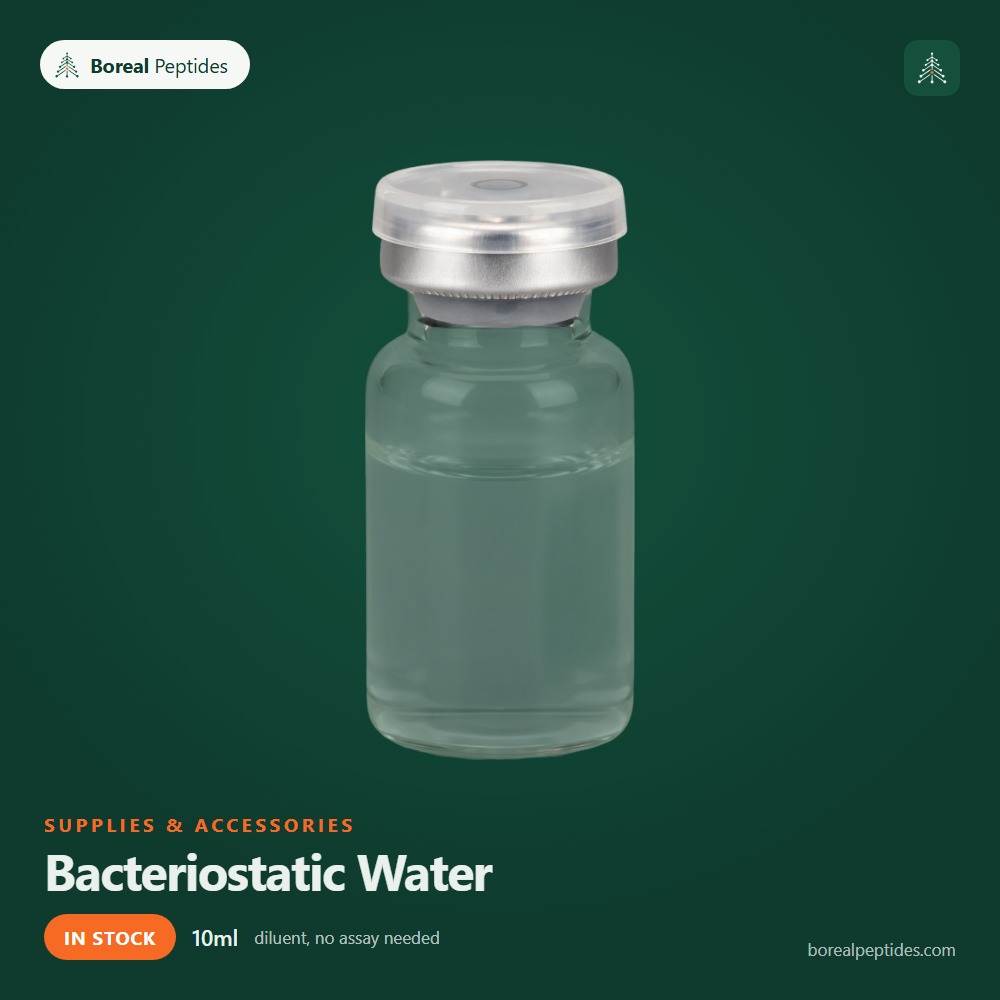
| Our vials | 3ml at $14 CAD and 10ml at $19 CAD, in stock November 12, 2026 |
Order for your research
Shipped from West Vancouver across Canada. Every result we hold is on the lab results page.

For laboratory research use only. Not for human or veterinary use.
Status checked November 12, 2026
Health Canada’s database shows the Pfizer Canada vial as marketed, with a status date of May 9, 2018. The DailyMed label we read is dated 08/2019 and was last posted on July 8, 2026. USP has a proposed change to the room temperature range that we couldn’t confirm as adopted. [1][6][7]
How long does bacteriostatic water last?
Bacteriostatic water lasts until its printed expiry date when sealed, and 28 days after the first puncture, unless the maker states another date. Two clocks run on every vial. The first is the expiry date, which governs an unopened vial. CDC says an unopened multi-dose vial should be discarded according to the manufacturer’s expiration date. [4] The Hospira label shows a lot number and an EXP date on the vial itself. [1]
The second clock is the 28-day rule after first puncture. CDC says the opened vial should be dated and discarded within 28 days, unless the manufacturer states another date, and it adds that this date should never be later than the original expiry. [4]
USP’s own FAQ matches that, and it quotes the chapter. After a multiple-dose compounded sterile preparation (CSP) is first entered, it has an assigned beyond-use date (BUD), and it “must not be used for longer than the assigned BUD or 28 days, whichever is shorter.” The FAQ also says multiple-dose containers aren’t used for more than 28 days “unless otherwise specified on the labeling.” [5]
Here’s the part other pages skip. The Hospira label doesn’t print “28 days” anywhere, and neither do the two other labels we opened. [1][2][3] The 28 days is a default from USP that applies “unless otherwise specified on the labeling.” [5] So if a maker’s label gives a different date, follow the label.
One more caution. USP and CDC wrote these rules for pharmacies and clinics, so a research lab isn’t bound by them. We use them because they’re the clearest published benchmark, and we don’t know of a stricter one.
Sealed vs opened: one table
| Sealed and unopened | After the first puncture | |
|---|---|---|
| How long | Until the printed EXP date [4] | Up to 28 days, never past the EXP date, unless the maker states another date [4][5] |
| Temperature on the label | 20 to 25°C (68 to 77°F) [1] | Same label, no separate opened-vial temperature [1] |
| Mark the vial | Note the lot and EXP date [1] | Write the date of first puncture on it [4] |
| Discard if | Past EXP, seal broken, cloudy, particles or colour change [1] | The same, or when day 28 passes [4][5] |
The labels tell users to inspect for clarity, particles and an intact seal. [1][2][3] After opening, the day-28 limit comes from CDC and USP. [4][5]
Does bacteriostatic water need to be refrigerated?
No. The labels we read don’t call for refrigeration. Each one says to store at 20 to 25°C and none mentions a refrigerator. [1][2][3] That’s the only storage instruction on them.
Some labs still chill opened vials. USP’s FAQ gives a reason: colder storage generally allows longer beyond-use dates for compounded preparations, because cold slows the growth of most microorganisms. [5] That statement is about compounded preparations, though, not about an opened diluent vial.
USP also keeps the 28-day entry limit separate from beyond-use dating. Its example is a vial with a 60-day beyond-use date that still “must still be discarded no later [than] 28 days after first puncture.” [5] We found no source saying cold storage stretches the opened-vial limit, so don’t count on it.
Can bacteriostatic water go bad?
Yes. Bacteriostatic water can go bad: the benzyl alcohol preservative holds back bacterial growth, and it isn’t a guarantee. The label lists it as a bacteriostatic preservative in a container “from which repeated withdrawals may be made.” [1] Every entry through the rubber stopper (the septum) is a chance for contamination, and the same label says to “use aseptic technique for single or multiple entry and withdrawal from all containers.” [1]
Signs to retire a vial:
- The liquid is cloudy, tinted or has particles in it, and the label says to inspect for particulate matter and discoloration. [1]
- The seal or stopper is damaged or lifted, and the label says not to use it unless the seal is intact. [1]
- The expiry date has passed.
- It’s more than 28 days since the first puncture, or since the date written on the vial. [4]
A clear vial isn’t proof of sterility, so the date rules exist, and we’d go by the calendar, not by looks.
What do the labels say about freezing or a hot car?
The labels give one storage range, 20 to 25°C, and don’t say what freezing or a hot car does. [1][2][3] USP’s current definition of controlled room temperature is 20° to 25°, with excursions allowed between 15° and 30°. [6] A proposed revision would lower the bottom of the range to 15° and cap an excursion at 24 hours. We couldn’t confirm it’s in force. [6]
Neither the labels nor the USP page we opened says what freezing or a hot car does to this product, so we can’t give you a verified number for either. Anything outside the printed range is a quality decision for your lab, and if you can’t justify keeping the vial, replace it.
Buying fresh bacteriostatic water in Canada
Our bacteriostatic water comes in two sizes, and the 3ml vial is $14 CAD while the 10ml vial is $19 CAD. Both were in stock on November 12, 2026, and orders ship across Canada from West Vancouver. Dispatch takes 1 to 2 business days, and delivery inside Canada then takes 2 to 4 business days. Shipping is free on orders of $299 or more. [8]
Here’s what we don’t publish. Our product page lists no third-party assay and no purity claim for it, and it doesn’t state a shelf life, so this guide doesn’t quote one for our vials. Read the lot and EXP date printed on the vial you receive, and write the date of first puncture on it. Ask us, if either is missing.
Health Canada’s database lists a Pfizer Canada bacteriostatic water for injection (DIN 00038202) under the Ethical schedule. [7] Read our guide on whether peptides are legal in Canada before you order. See every lab result we hold, or learn how to read a peptide certificate of analysis (COA). More from Boreal Peptides is in our guides.
Ready to order?
Shipped from West Vancouver across Canada. Every result we hold is on the lab results page.
For laboratory research use only. Not for human or veterinary use.
People also ask
How long does bacteriostatic water last?
A sealed vial lasts until the expiry date printed on it. After the first puncture, discard it within 28 days or at the expiry date, whichever comes first, unless the maker states another date. [1][4][5]
Read more: How long does bacteriostatic water last?
Does bacteriostatic water need to be refrigerated?
No. The labels we read say to store it at 20 to 25°C and don’t mention refrigeration. Some labs chill opened vials, but we found no source saying cold storage extends the 28-day limit. [1][2][3][5]
Read more: Does bacteriostatic water need to be refrigerated?
Does bacteriostatic water expire?
Yes. Bacteriostatic water expires, and the Hospira vial label carries a lot number and an EXP date. CDC says an unopened multi-dose vial should be discarded by the manufacturer’s expiration date. [1][4]
Read more: How long does bacteriostatic water last?
Can bacteriostatic water go bad?
Yes. Bacteriostatic water can go bad: benzyl alcohol is a preservative, not a guarantee, and each entry through the stopper is a chance for contamination. Cloudiness, particles, a damaged seal or a passed date mean the vial should be retired. [1][4]
Read more: Can bacteriostatic water go bad?
Is the 28-day rule printed on the label?
No. The 28-day rule isn’t printed on the Hospira label we read, or on the two other labels we opened. The 28 days is a USP default that applies unless the labeling says otherwise, so a maker’s own date takes priority. [1][2][3][5]
Read more: How long does bacteriostatic water last?
Can I keep using it past 28 days if it still looks clear?
No. CDC and USP both say to discard the vial by day 28. A clear look doesn’t show a vial is sterile, which is why the rule is based on dates. [4][5]
Read more: Can bacteriostatic water go bad?
Sources and methodology
This guide draws on three DailyMed labels for bacteriostatic water for injection and CDC’s injection safety guidance, and it also uses USP’s <797> FAQs, its Packaging and Storage chapter page and Health Canada’s Drug Product Database. It also uses our own product page, and claims link to numbered sources below. We opened each source on November 12, 2026. It contains no dosing information and makes no claim that any compound treats, prevents or improves any condition.
How this guide was made: we researched and drafted it with AI assistance. We then checked every claim against its cited source, and the owner of Boreal Peptides reviewed it before publication.
Last reviewed: November 12, 2026. Next review: May 2027, or sooner if USP adopts its proposed room temperature change. Read our editorial policy.
Research use only
For laboratory research use only. Not for human or veterinary use. Nothing here is medical advice. Boreal Peptides supplies compounds to laboratory researchers. Read our research use disclaimer.
Sources
- Hospira, Inc. Bacteriostatic Water for Injection, USP, multiple-dose vials (label LAB-0977-2.0, revised 08/2019). DailyMed, posted July 8, 2026. https://dailymed.nlm.nih.gov/dailymed/drugInfo.cfm?setid=87d6e9dc-fe3b-4593-ac9a-d7493d1959c7
- Henry Schein, Inc. Bacteriostatic Water Injection, USP, 30 mL multi-dose vial (repackaged Hospira label). DailyMed, posted October 28, 2026. https://dailymed.nlm.nih.gov/dailymed/drugInfo.cfm?setid=a833502e-a622-4e81-8c58-cef6ccb6c4c9
- ProPharma Distribution. Bacteriostatic Water Injection, USP, 30 mL vial. DailyMed, posted November 17, 2025. https://dailymed.nlm.nih.gov/dailymed/drugInfo.cfm?setid=42c6938e-f747-ae13-e063-6294a90a59a3
- Centers for Disease Control and Prevention. Preventing Unsafe Injection Practices. March 26, 2024. https://www.cdc.gov/injection-safety/hcp/clinical-safety/index.html
- United States Pharmacopeia. USP <797> Pharmaceutical Compounding, Sterile Preparations: FAQs. Updated December 11, 2023. https://pages.usp.org/rs/711-SXF-172/images/USP_HQS_797_FAQs_December2023_V6__002.pdf
- United States Pharmacopeia. <659> Packaging and Storage Requirements (controlled room temperature and proposed revision). https://doi.usp.org/USPNF/USPNF_M2773_60101_01.html
- Health Canada. Drug Product Database, DIN 00038202, Bacteriostatic Water for Injection USP, Pfizer Canada ULC, checked November 12, 2026. https://health-products.canada.ca/dpd-bdpp/info?lang=eng&code=117
- Boreal Peptides. Shipping and delivery, read November 12, 2026. https://borealpeptides.com/shipping-and-delivery/