Bacteriostatic Water vs Sterile Water (and Saline): What Differs

Quick answer
Bacteriostatic water vs sterile water comes down to one ingredient. Bacteriostatic water has 0.9% benzyl alcohol as a preservative and is labelled multiple-dose. Sterile water for injection has none and is single-dose. Saline is salt in water, with or without that preservative. “Mixing solution” isn’t a standard label name, so read the ingredient list. [1][2][3][4]
Key facts
- US labels describe bacteriostatic water as sterile, nonpyrogenic water with 0.9% (9 mg/mL) or 1.1% (11 mg/mL) benzyl alcohol. [1]
- Sterile water for injection “contains no bacteriostat, antimicrobial agent or added buffer.” [2]
- Both the water and the saline versions that carry benzyl alcohol are labelled “not for use in neonates.” [1][3]
- Health Canada lists bacteriostatic water for injection as a drug product with a Drug Identification Number (DIN), and Health Canada says “For Research Use Only” labelling “does not make these products legal or exempt from regulatory requirements.” [5][8]
- Our bacteriostatic water has no third-party assay, so it carries no purity claim. [14][15]
| At a glance | Summary |
|---|---|
| Bacteriostatic water | Sterile water plus 0.9% benzyl alcohol (some US labels use 1.1%) [1] |
| Sterile water for injection | Water only, no preservative, single-dose containers [2] |
| 0.9% sodium chloride (saline) | 9 mg of sodium chloride per mL; the plain version has no preservative [4] |
| Bacteriostatic sodium chloride | Saline plus 0.9% benzyl alcohol, multiple-dose vials [3] |
| “Mixing solution” or “diluent” | A seller’s name, not a pharmacopoeial one; the label decides what it is |
| Boreal product | 3ml and 10ml vials, CAD $14.00 to $19.00, in stock, no third-party assay [14] |
Order for your research
Shipped from West Vancouver across Canada. Every result we hold is on the lab results page.

For laboratory research use only. Not for human or veterinary use.
Bacteriostatic water vs sterile water: the short answer
The two liquids start the same way, and both are water that has been made sterile. The difference is one added ingredient: bacteriostatic water has a preservative, and sterile water for injection is preservative-free sterile water. [1][2]
That one ingredient changes how each is packaged. On a US label, a preservative lets a manufacturer sell a multi-dose vial and label it multiple-dose, but without one the label says the container is single-dose and any unused liquid is discarded. [1][2]
| Liquid | What’s in it | Preservative | Container on US labels | Ships with our orders? |
|---|---|---|---|---|
| Bacteriostatic water | Sterile water, 0.9% benzyl alcohol | Yes, benzyl alcohol | Multiple-dose | Sold as its own product, 3ml and 10ml [1][14] |
| Sterile water for injection | Water only | None | Single-dose | No, we don’t list it [2][14] |
| 0.9% sodium chloride | 9 mg/mL sodium chloride in water | None in the plain version | Single-dose | No [4] |
| Bacteriostatic sodium chloride | Sodium chloride plus 0.9% benzyl alcohol | Yes, benzyl alcohol | Multiple-dose | No [3] |
We can’t say that any liquid ships automatically with a Boreal order, and our bacteriostatic water is a separate product that you add to the cart. [14]
What is bacteriostatic water?
Bacteriostatic water is sterile water with a preservative added, usually 0.9% benzyl alcohol. [1] A bacteriostatic agent is one that stalls bacterial activity without directly causing bacterial death. [13] That’s the meaning of the word in the name, and the shorthand “bac water” is the same liquid under a shorter name. The water doesn’t kill everything that lands in it, but it holds bacteria back instead, limiting microbial growth.
On a US label, the maker describes bacteriostatic water for injection as a sterile, nonpyrogenic preparation that contains benzyl alcohol “added as a bacteriostatic preservative.” The label says it’s for diluting or dissolving drugs only. [1]
Health Canada’s Drug Product Database lists a Pfizer Canada product with this name, DIN 00038202, as marketed in 30 mL vials. [5]
What is in bacteriostatic water?
Bacteriostatic water contains two label ingredients: water for injection and benzyl alcohol. [1]
- Water for injection. This is water that has been made sterile and nonpyrogenic, and its formula is H2O (two hydrogen atoms bonded to one oxygen atom), with a molecular weight of 18.015. [12]
- Benzyl alcohol, 0.9% (9 mg/mL). Some US labels use a higher alcohol concentration, 1.1% (11 mg/mL) instead, but it’s the preservative either way. [1]
Benzyl alcohol is a small organic molecule with the formula C7H8O and a molecular weight of 108.14. [11] That’s the whole list, and there’s no salt, no buffer and no active drug.
Its preservative role comes with a warning, and a 1982 New England Journal of Medicine report, “The gasping syndrome and benzyl alcohol poisoning,” linked a syndrome in premature infants to benzyl alcohol. [10] The Centers for Disease Control (CDC) reported 16 newborn deaths thought to be caused by benzyl alcohol in a preserved saline used to flush catheters, and they stopped after hospitals switched to preservative-free solutions. [9] That’s why current labels carry the line “not for use in neonates.” [1][3]
Is bacteriostatic water the same as saline or a “mixing solution”?
No. Bacteriostatic water, saline and a “mixing solution” aren’t the same thing, and four names get used as if they meant one thing. [1][2][3][4]
| Name | What it tells you | What to check on the label |
|---|---|---|
| Bacteriostatic water | Water plus 0.9% benzyl alcohol | The preservative and its strength |
| Sterile water for injection | Water only | That it says “single-dose” and lists no preservative |
| 0.9% sodium chloride | Salt in water, 9 mg/mL | Whether it lists a preservative |
| Bacteriostatic sodium chloride | Salt in water plus 0.9% benzyl alcohol | Both the salt strength and the preservative |
Saline is the odd one out, since it isn’t water with a preservative, but it is water with 9 mg of sodium chloride in each mL. [4] The plain version “contains no preservatives,” and the preserved one adds 0.9% benzyl alcohol. [3][4]
Some suppliers sell a liquid under the name “diluent” or “mixing solution.” In the labels we read, that wording wasn’t a product name, and we found no regulator or label that uses it as a category. So it can be bacteriostatic water, sterile water, saline or bacteriostatic saline, and the ingredient list is the only reliable guide. [1][2][3][4]
One more point about sterile water. Its label carries a clinical warning about hemolysis, the rupture of red blood cells, when no solute is present. That’s a hospital-labelling point, not a lab tip, but it does show why the four liquids aren’t interchangeable. [2]
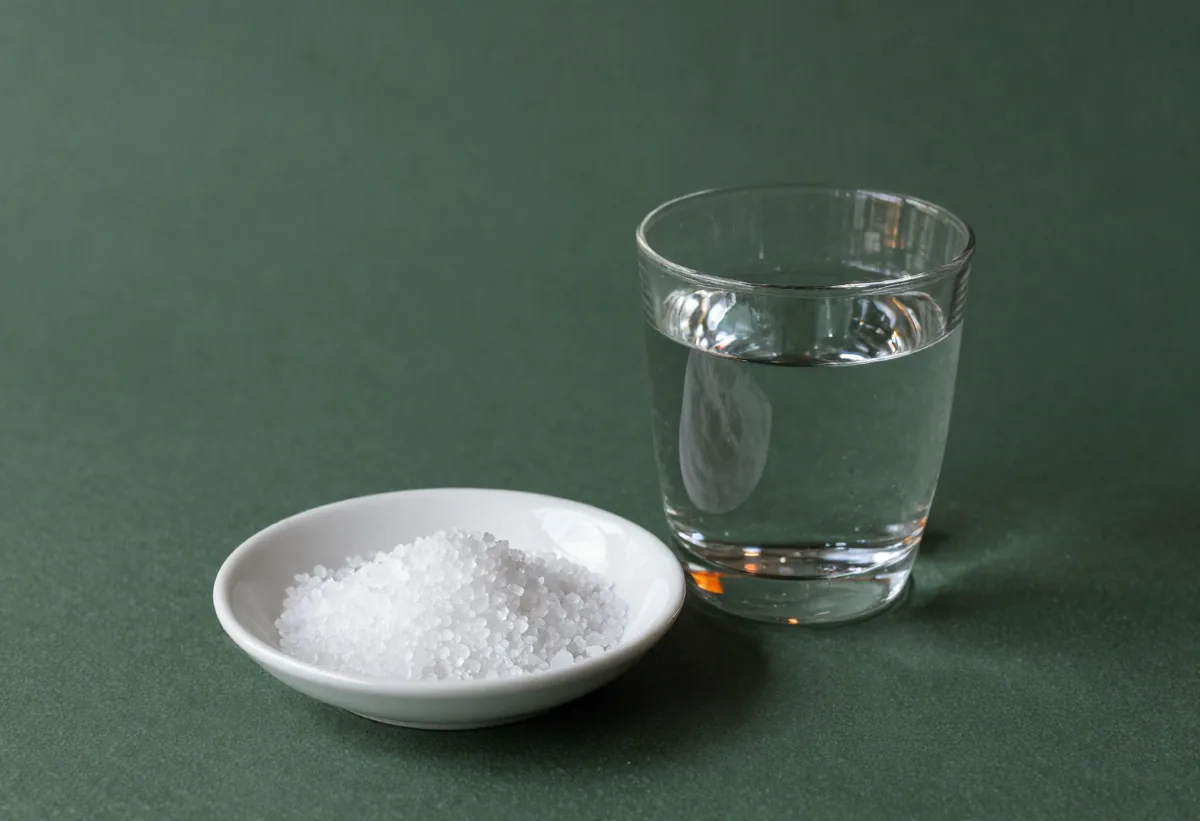
When does the preservative rule it out?
The preservative rules the liquid out in some settings, since the labels for the benzyl alcohol versions carry the neonate warning, and the CDC and the US Food and Drug Administration (FDA) advised against these preserved liquids for newborns. [1][3][9]
What is bacteriostatic water used for in labs?
Bacteriostatic water’s labelled purpose is narrow: the US maker’s label says it’s for diluting or dissolving drugs, and it isn’t a fluid or a drug. [1]
In research settings, a preserved diluent is one option among others, and which liquid a lab picks depends on its own written procedures, so we don’t advise on that. Our own pages list it as laboratory research supplies, and this guide doesn’t give steps, volumes or handling instructions. [14]
Status checked November 12, 2026
- Pfizer Canada, bacteriostatic water for injection USP (United States Pharmacopeia), DIN 00038202: marketed in the Drug Product Database, with the status date May 9, 2018. [5]
- Omega Laboratories, bacteriostatic water for injection USP, DIN 02131536: dormant since July 23, 2021. [7]
- Sterinova, sterile water for injection USP, DIN 02542145: marketed, with the status date May 27, 2026. [6]
- Health Canada’s position on research labels: advisory RA-81874, April 9, 2026. It says “For Research Use Only” labelling “does not make these products legal or exempt from regulatory requirements.” It advises Canadians not to buy or use products labelled this way. [8]
- Our product: no third-party assay and no purity claim, and the product page doesn’t state the preservative or its strength. [14][15]
Buying bacteriostatic water in Canada
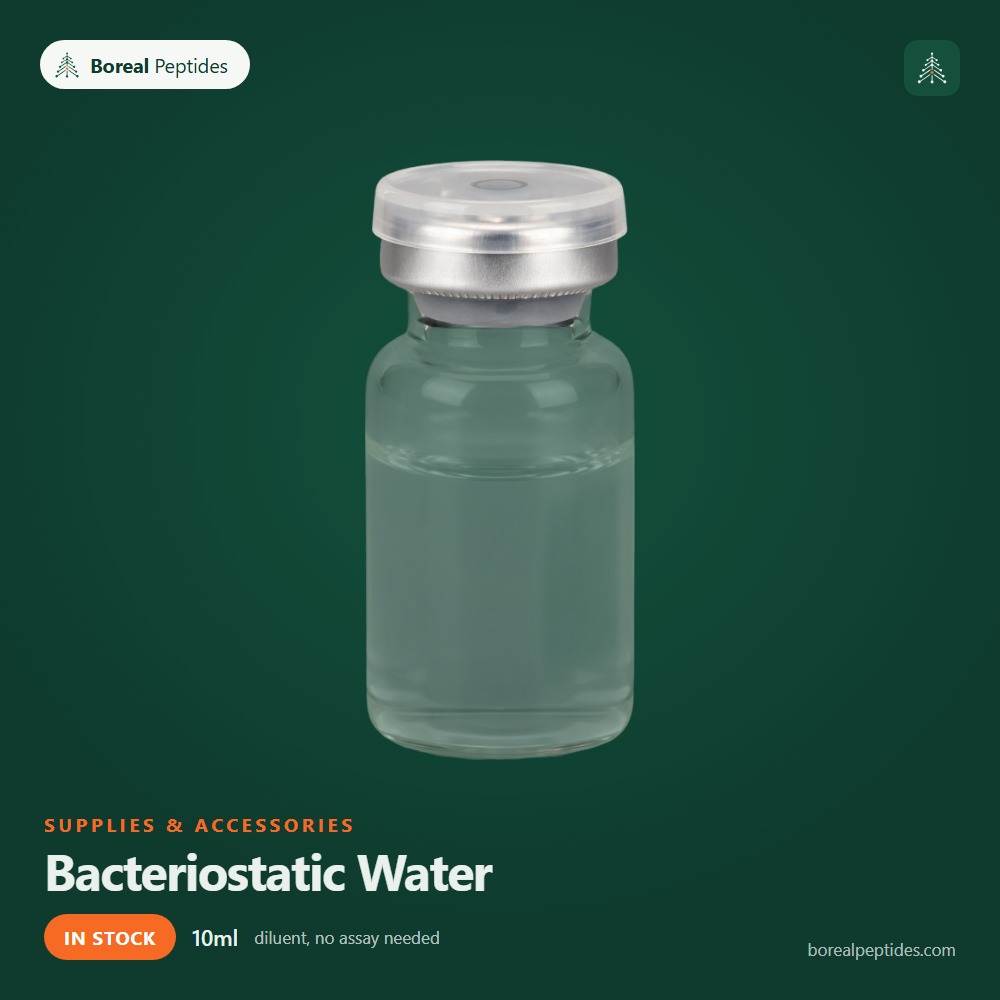
We sell it in two sizes: 3ml and 10ml. The page lists the price range as CAD $14.00 to $19.00, and it shows the item in stock today. [14]
Here’s what we can and can’t say about it:
- It’s described as sterile water containing a bacteriostatic agent. [14]
- The page doesn’t name the agent or give a strength. Ask us before ordering, if you need to know. [14]
- It has no certificate of analysis (COA), and our lab results page lists bacteriostatic water among the fourteen products with no certificate. [15]
- It’s for laboratory research use only. Health Canada says “For Research Use Only” labelling does not make products legal or exempt from regulatory requirements. [8]
Drug-labelled versions have DINs in the Drug Product Database, but our product page doesn’t list one. [5][14]
The bacteriostatic water product page has both sizes, if you’d like to see the product. You can also read how to read a peptide COA to see what a certificate does and doesn’t cover. For everything else we stock, start at the Boreal Peptides homepage.
Ready to order?
Shipped from West Vancouver across Canada. Every result we hold is on the lab results page.
For laboratory research use only. Not for human or veterinary use.
People also ask
What is bacteriostatic water?
Bacteriostatic water is sterile water with a preservative added, usually 0.9% benzyl alcohol. The word “bacteriostatic” means the preservative stalls bacterial activity without directly causing bacterial death. [1][13]
Read more: What is bacteriostatic water?
Is bacteriostatic water the same as sterile water?
No. Sterile water for injection has no preservative and comes in single-dose containers. Bacteriostatic water adds 0.9% benzyl alcohol and is labelled as a multiple-dose container. [1][2]
Read more: The short answer
What is in bacteriostatic water?
Two things: sterile water and benzyl alcohol at 0.9% (9 mg/mL). Some US labels use 1.1%. It has no salt, buffer or active drug. [1]
Read more: What is in bacteriostatic water?
What is bacteriostatic water used for?
Bacteriostatic water’s US label says it’s for diluting or dissolving drugs. It’s not a fluid or a drug itself. [1]
Is bacteriostatic water the same as saline?
No. Saline is sodium chloride in water, at 9 mg/mL. Bacteriostatic water has no salt. A bacteriostatic version of saline also exists, with 0.9% benzyl alcohol. [3][4]
Read more: Saline and mixing solutions
Is bacteriostatic water the same as a “mixing solution”?
No, not by name. “Mixing solution” isn’t a label category in the sources we read. It could be any of the four liquids, so check the ingredient list. [1][2][3][4]
Read more: Saline and mixing solutions
Sources and methodology
This guide uses US drug labels for the four liquids, Health Canada’s Drug Product Database and advisory RA-81874, the CDC, a peer-reviewed report, PubChem and our own product page, and each claim links to a numbered source below. The labels are US labels, and Canadian versions can differ, and we checked Boreal’s own facts against our product page and lab results page on November 12, 2026.
How this guide was made: we researched and drafted it with AI assistance. We then checked every claim against its cited source, and the owner of Boreal Peptides reviewed it before publication.
Last reviewed: November 12, 2026. Next review: May 2027, or sooner if a label or the Drug Product Database changes. Read our editorial policy.
Research use only
For laboratory research use only. Not for human or veterinary use. Nothing here is medical advice. Boreal Peptides supplies compounds for laboratory research use only. Read our research use disclaimer.
Sources
- Hospira, Inc. Bacteriostatic Water for Injection, USP (multiple-dose vial), US drug label, revised 08/2019. https://labeling.pfizer.com/ShowLabeling.aspx?id=4666
- Hospira, Inc. Sterile Water for Injection, USP (single-dose vial), US drug label, revised 03/2026. https://labeling.pfizer.com/ShowLabeling.aspx?id=4672
- Hospira, Inc. Bacteriostatic Sodium Chloride Injection, USP, US drug label, revised 02/2019. https://labeling.pfizer.com/ShowLabeling.aspx?id=4614
- Hospira, Inc. Sodium Chloride Injection, USP 0.9% (single-dose), US drug label, revised 08/2021. https://labeling.pfizer.com/ShowLabeling.aspx?id=4615
- Health Canada. Drug Product Database: Bacteriostatic Water for Injection USP, Pfizer Canada ULC, DIN 00038202. Checked November 12, 2026. https://health-products.canada.ca/dpd-bdpp/info?lang=eng&code=117
- Health Canada. Drug Product Database: Sterile Water for Injection USP, Sterinova Inc., DIN 02542145. Checked November 12, 2026. https://health-products.canada.ca/dpd-bdpp/info?lang=eng&code=103074
- Health Canada. Drug Product Database: Bacteriostatic Water for Injection USP, Omega Laboratories Limited, DIN 02131536. Checked November 12, 2026. https://health-products.canada.ca/dpd-bdpp/info?lang=eng&code=17402
- Health Canada. Think twice before injecting peptides bought online: unauthorized products can seriously harm you (RA-81874). April 9, 2026. https://recalls-rappels.canada.ca/en/alert-recall/think-twice-injecting-peptides-bought-online-unauthorized-products-can-seriously-harm
- Centers for Disease Control. Neonatal deaths associated with use of benzyl alcohol, United States. Morbidity and Mortality Weekly Report. https://www.cdc.gov/mmwr/preview/mmwrhtml/00001109.htm
- Gershanik J, Boecler B, Ensley H, McCloskey S, George W. The gasping syndrome and benzyl alcohol poisoning. New England Journal of Medicine, 1982;307(22):1384-1388. doi:10.1056/NEJM198211253072206. https://pubmed.ncbi.nlm.nih.gov/7133084/
- National Center for Biotechnology Information. PubChem Compound Summary, CID 244, Benzyl alcohol. https://pubchem.ncbi.nlm.nih.gov/compound/244
- National Center for Biotechnology Information. PubChem Compound Summary, CID 962, Water. https://pubchem.ncbi.nlm.nih.gov/compound/962
- StatPearls Publishing. Bacteriostatic Antibiotics. NCBI Bookshelf, last update August 14, 2023. https://www.ncbi.nlm.nih.gov/sites/books/n/statpearls/article-18105/
- Boreal Peptides. Bacteriostatic Water product page, checked November 12, 2026. https://borealpeptides.com/bacteriostatic-water/
- Boreal Peptides. Lab results and certificates, checked November 12, 2026. https://borealpeptides.com/lab-results/