

Quick answer
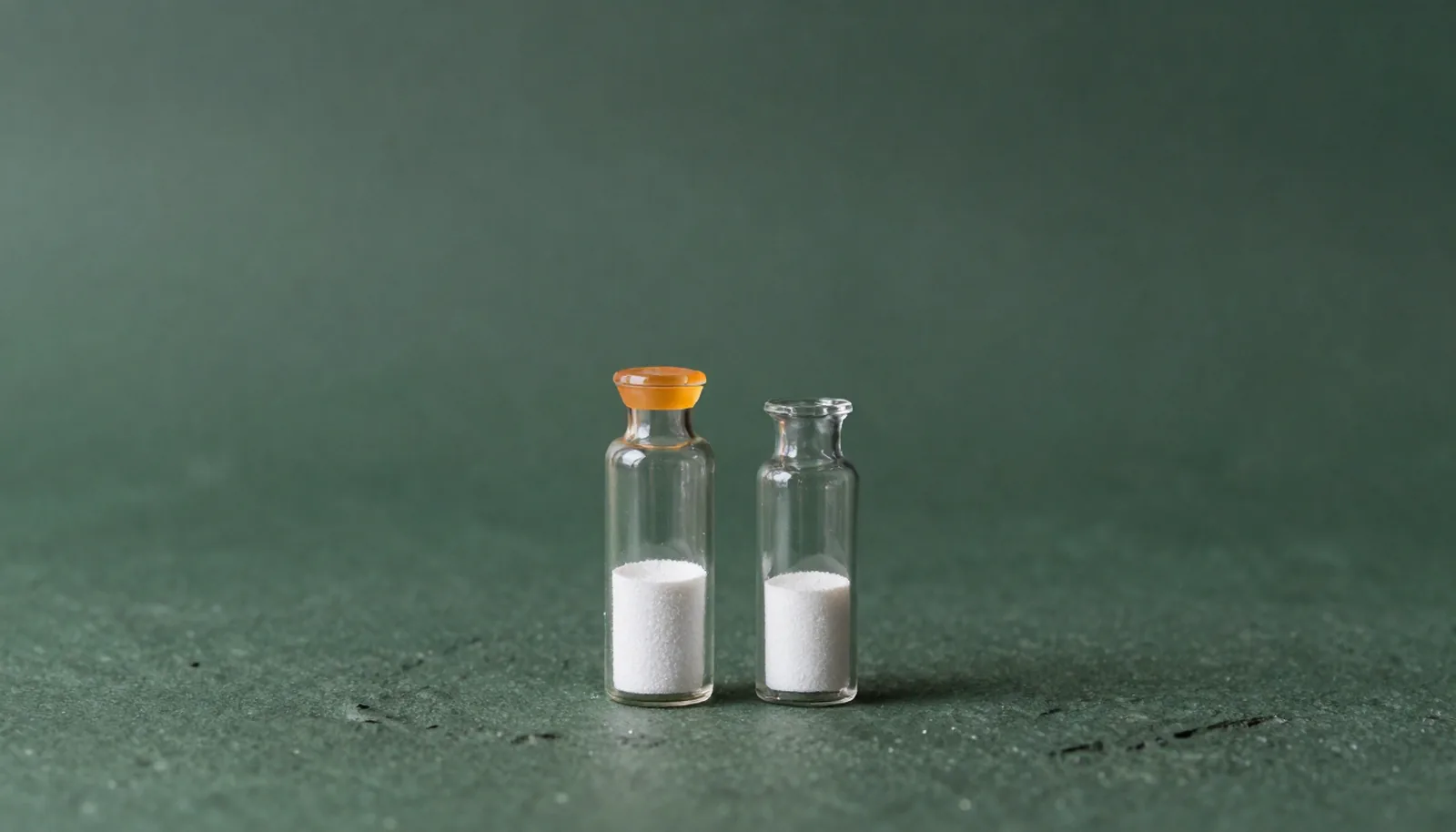
BPC-157 is a 15-amino-acid synthetic peptide, described as originally isolated from gastric juice. TB-500 is a 7-amino-acid fragment of thymosin beta-4. They differ in origin, size and the pathways studied, and they’re paired because both appear in tendon and wound models, yet one 2026 rat study found the pair did no better than either alone. [8][9][19]
BPC-157 vs TB-500: the short answer
The two peptides don’t share a size, a source or a main pathway, so they aren’t interchangeable. Here’s the side-by-side.
Key facts
- BPC-157 has 15 amino acids and a molecular weight of about 1,419.5, and TB-500 has 7 and weighs about 889.0. [8][9]
- Much TB-500 research borrows from work on full-length thymosin beta-4, a different molecule, and BPC-157 work in tendons includes a 2003 Zagreb rat study. [13][15][16][17]
- The only controlled animal study we found that tested both, alone and together, was a 2026 rat tendon study, and the pair didn’t beat the single peptides. [19]
- A 2026 systematic review found 3 human studies of BPC-157, 30 people in total, with very low certainty, and for TB-500 the US Food and Drug Administration (FDA) found no human exposure data. [3][12]
- Neither has a product in Health Canada’s Drug Product Database, and the World Anti-Doping Agency (WADA) 2026 list prohibits both at all times. [2][6]
| At a glance | BPC-157 | TB-500 |
|---|---|---|
| Origin | Synthetic, described as originally isolated from gastric juice [11] | Synthetic fragment of thymosin beta-4, residues 17 to 23 [9][18] |
| Size and sequence | 15 amino acids, GEPPPGKPADDAGLV [8][13] | 7 amino acids, Ac-LKKTETQ [9] |
| Formula and weight | C62H98N16O22, 1,419.5 [8] | C38H68N10O14, 889.0 [9] |
| Pathways studied | Vascular endothelial growth factor (VEGF), nitric oxide, extracellular signal-regulated kinase 1 and 2 (ERK1/2), alpha serine/threonine-protein kinase (AKT), FAK-paxillin, growth hormone receptor [10][14] | Actin binding, cell migration, new blood vessel growth (mostly shown with thymosin beta-4) [15][16] |
| Main models | Rat tendon, ligament and muscle injury, and cultured tendon cells [10][13] | Cell and chick vessel assays; rat tendon (TB-500) and ligament (full-length protein) models [16][17][19] |
| Human evidence | 3 small studies, 30 people, very low certainty [12] | None found by the FDA for TB-500 [3] |
| WADA 2026 list | Named in S0 [6] | Named in S2.3 as a thymosin-beta-4 derivative [6] |
| Our tested vial | 99.781%, Janoshik, batch (GYC4CQSX) [21] | 98.99%, Medutest, batch WWB-BT10-7694 [21] |
Order for your research
Shipped from West Vancouver across Canada. Every result we hold is on the lab results page.

BPC-157 is a synthetic pentadecapeptide, fifteen amino acids, originally isolated from human gastric juice.

TB-500 is a synthetic fragment of thymosin beta-4, corresponding to residues 17 to 23 of the parent protein.
For laboratory research use only. Not for human or veterinary use.
What is BPC-157?
BPC-157 is a synthetic chain of 15 amino acids (a pentadecapeptide), and reviews describe it as originally isolated from human gastric juice. [11] Its name stands for Body Protection Compound.
A 2003 rat Achilles tendon paper on it came from the University of Zagreb in Croatia, from the group of Predrag Sikiric. [13]
We cover its structure and Canadian status in full in our guide, What is BPC-157?.
What is TB-500?
TB-500 is a seven-amino-acid peptide, Ac-LKKTETQ, with an acetyl cap at one end. [9] Its sequence matches residues 17 to 23 of thymosin beta-4, a 43-amino-acid protein. [16][18]
That makes it a fragment, not thymosin beta-4 itself, and a 2026 orthopaedic review notes TB-500 is often confused with the full protein, with no validated proof the two act alike. [20]
The FDA’s list names the same sequence: “thymosin beta-4, fragment (LKKTETQ), also known as TB-500”. [3]
Why are BPC-157 and TB-500 often paired?
The short reason is that the two peptides turn up in the same kinds of studies, but they point to different pathways. Reviews of BPC-157 report VEGF, nitric oxide and growth-signal pathways. [10] Thymosin beta-4 work centres on actin, a protein cells use to move, and on how new blood vessels form. [15][16]
Both turn up in tissue repair research, in tendon and ligament models and in wound healing models. A reader of the literature could ask whether the two overlap or add up. That’s a research question, and this guide gives no advice on combining anything.
What’s the “Wolverine stack”? It’s an informal nickname, not a scientific term, and it refers to BPC-157 and TB-500 sold or discussed as a pair. The name is borrowed from the comic book character known for fast healing. Even the label itself isn’t settled: a 2026 preprint uses “Wolverine Peptide” for BPC-157 alone. [28]
Keep one fact in mind. The best direct test we found is the 2026 rat Achilles study, and its authors reported no added effect from the pair. [19]
Which blends already contain both?
Two of our listed blends contain both compounds, GLOW (a 70 mg blend) and KLOW (an 80 mg blend), and both are out of stock on 12 November 2026. [24][25][26]
| Blend | Contents (total mass) | Testing on file | Stock, 12 Nov 2026 |
|---|---|---|---|
| GLOW | BPC-157 10 mg, GHK-Cu 50 mg, TB-500 10 mg (70 mg) | No certificate, finished-blend assay pending [24] | Out of stock |
| KLOW | TB-500 10 mg, BPC-157 10 mg, KPV (Lys-Pro-Val) 10 mg, GHK-Cu 50 mg (80 mg) | Medutest MT-12327, 99.63%, but its identity data describes GHK-Cu only [25] | Out of stock |
The only difference between the two is KPV, and neither is four or three equal parts, because GHK-Cu makes up 50 mg of each vial. [24][25]
We don’t claim either was assayed as a finished blend, and a certificate that describes one component can’t confirm the others. Our blends page explains the gap. [26] A direct KLOW and GLOW comparison guide is planned.
How do BPC-157 and TB-500 differ in studies?
BPC-157 and TB-500 studies differ in model and measured outcome, and all of them come from cell and animal models. The table lists what each study measured, with its model and year, and none of it shows an effect in people.
| Study | Model | What was measured |
|---|---|---|
| Staresinic et al., 2003, BPC-157 [13] | Rat, cut Achilles tendon | Load to failure, a walking-function index, tissue under the microscope |
| Chang et al., 2014, BPC-157 [14] | Cultured rat tendon cells | Growth hormone receptor levels and cell proliferation |
| Philp et al., 2003, thymosin beta-4 and its 7-residue motif [16] | Human endothelial cells, chick aortic rings | Cell migration, adhesion and vessel sprouting |
| Xu et al., 2013, full-length thymosin beta-4 [17] | Rat, cut medial collateral ligament | Fibre organization and mechanical strength at 4 weeks |
| Biçer et al., 2026, BPC-157, TB-500 and both [19] | Rat, cut and repaired Achilles tendon | Load to failure, tendon scores, collagen staining at 4 weeks |
What did the 2026 rat study find?
Thirty-two rats were split into four groups of eight: control, BPC-157, TB-500, and both. After four weeks, TB-500 was the only group with a significant gain in load to failure. [19]
TB-500 and the combined group scored better on a tendon structure scale, but BPC-157 alone didn’t reach significance on total scores. The pair showed no benefit beyond either peptide alone. [19]
The authors call it exploratory. Groups were tiny (four tendons per test), outcomes came from a single time point, and the rats were young and healthy. [19]
What the older work can and can’t tell you
The 2003 BPC-157 paper and the 2013 ligament paper both used cut tendons or ligaments in rats. [13][17] The ligament study used full-length thymosin beta-4, so it isn’t a TB-500 result. [17]
In people, the picture is thin, and a 2026 systematic review found three BPC-157 studies, 30 people in all, rated “very low” certainty. [12] The 2026 orthopaedic review says direct muscle and tendon evidence for thymosin beta-4 stops at cells and rodents. [20]
What is the Canadian status of BPC-157 and TB-500?
Neither BPC-157 nor TB-500 has a product in Health Canada’s Drug Product Database, and both are named in its April 9, 2026 advisory on unauthorized injectable peptide drugs. [2][1]
Status checked 12 November 2026
Health Canada: Neither has a product in the Drug Product Database, and we searched for “bpc”, “body protection”, “thymosin” and “tb-500”. [2] Health Canada’s April 9, 2026 advisory (RA-81874) lists BPC-157 and TB-500 among unauthorized injectable peptide drugs it seized. It also says “For Research Use Only” labelling “does not make these products legal or exempt from regulatory requirements,” and it advises Canadians not to buy or use products labelled that way. [1]
FDA: The FDA compounding lists, on a page current as of April 22, 2026, place both under “nominated but withdrawn”, and for TB-500 the page says the FDA “has not identified any human exposure data”. [3] An advisory committee discussed both on July 23, 2026, and press reports say it voted 8 to 6 with one abstention to recommend compounding, but that’s a non-binding recommendation. [4][5]
WADA: The 2026 list names BPC-157 in S0, and section S2.3 names “Thymosin-β4 and its derivatives e.g. TB-500”. Both are prohibited at all times. [6] WADA’s executive committee approved a 2027 list on September 10, 2026, effective January 1, 2027, but we couldn’t confirm its wording for these two. [7]
For the wider legal picture, see Are peptides legal in Canada?.
How to tell them apart on a certificate of analysis
A certificate of analysis (COA) should show a mass that matches the molecule, and that’s the quickest way to tell these two apart. Start with how to read a peptide COA, if you aren’t sure how to read one.
| Check | BPC-157 | TB-500 |
|---|---|---|
| Molecular weight | About 1,419.5 [8] | About 889.0 [9] |
| Formula | C62H98N16O22 [8] | C38H68N10O14 [9] |
| Chemical Abstracts Service (CAS) number | 137525-51-0 [8] | 885340-08-9 [9] |
| Residues | 15 | 7, acetylated |
| Our result | 99.781%, Janoshik report #51140, issued 21 Feb 2026 [21] | 98.99%, Medutest report MT-52854, issued 3 Feb 2026 [21] |
Both results come from high-performance liquid chromatography (HPLC), which measures identity and purity in the tested lot, but it doesn’t measure sterility, endotoxin or heavy metals. [21]
For a blend, the identity block should describe more than one compound, and our KLOW certificate doesn’t. [25] See every lab result we hold.
Buying them for research in Canada
Prices and stock below were read from the product pages on 12 November 2026, and they can change.
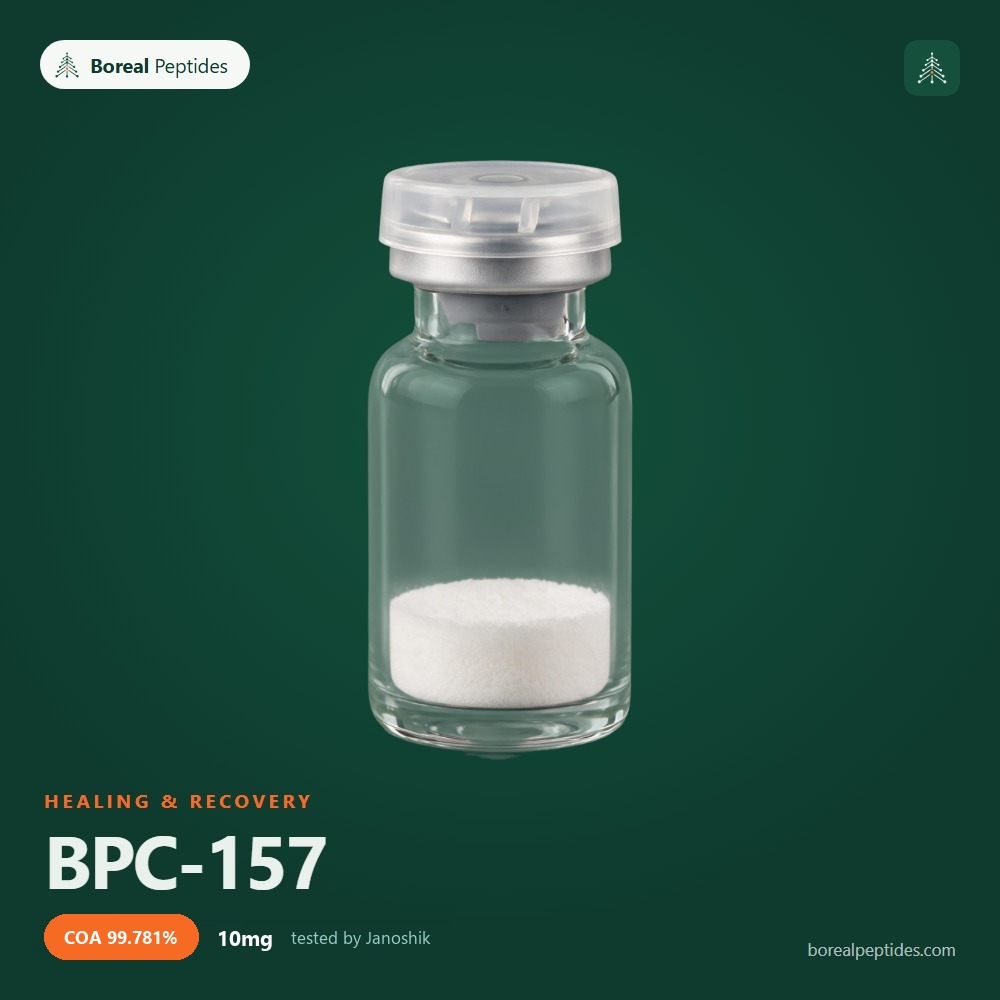
- BPC-157 10 mg: CAD 60.00, in stock. Janoshik result 99.781%, batch GYC4CQSX. [22]
- TB-500 10 mg: CAD 98.00, in stock. Medutest result 98.99%, batch WWB-BT10-7694. [23]
- GLOW and KLOW: out of stock. [24][25]
The product pages advertise free shipping on carts that reach CAD 299, and the batch reference travels on the packing slip. [22][23] Every order is placed under our research use disclaimer. Nothing on this site is authorized for sale as a drug in Canada. [27]
Read more about healing peptides and the research behind them, or return to the Boreal Peptides homepage.
Ready to order?
Shipped from West Vancouver across Canada. Every result we hold is on the lab results page.
BPC-157 is a synthetic pentadecapeptide, fifteen amino acids, originally isolated from human gastric juice.
TB-500 is a synthetic fragment of thymosin beta-4, corresponding to residues 17 to 23 of the parent protein.
For laboratory research use only. Not for human or veterinary use.
People also ask
What is the difference between BPC-157 and TB-500?
BPC-157 and TB-500 differ in size, origin and pathways studied. BPC-157 has 15 amino acids and was described from gastric juice, but TB-500 has 7 and is a fragment of thymosin beta-4. [8][9][11]
Read more: BPC-157 vs TB-500: the short answer
What is the “Wolverine stack”?
The “Wolverine stack” is an informal nickname for BPC-157 and TB-500 discussed as a pair, and it isn’t a scientific term. This guide gives no advice on combining either peptide. [28]
Read more: Why are BPC-157 and TB-500 often paired?
Has any study tested BPC-157 and TB-500 together?
Yes. We found one study that tested BPC-157 and TB-500 together. A 2026 rat Achilles tendon study compared each peptide and the pair, and the pair showed no benefit beyond either alone. [19]
Read more: How do BPC-157 and TB-500 differ in studies?
Is TB-500 the same as thymosin beta-4?
No. TB-500 is a 7-amino-acid fragment, residues 17 to 23, of the 43-amino-acid thymosin beta-4, and a 2026 review says no validated proof shows the two act alike. [16][20]
Read more: What is TB-500?
Does Health Canada’s Drug Product Database list BPC-157 or TB-500?
No. Neither has a product in Health Canada’s Drug Product Database, and both appear in its April 2026 advisory on seized unauthorized peptides. [1][2]
Read more: What is the Canadian status of BPC-157 and TB-500?
Are BPC-157 and TB-500 banned in sport?
Yes. WADA’s 2026 list names BPC-157 in S0 and TB-500 in S2.3, both prohibited at all times. [6]
Read more: What is the Canadian status of BPC-157 and TB-500?
Which Boreal blends contain both?
GLOW and KLOW contain both, but both are out of stock on 12 November 2026, and neither has a finished-blend assay. [24][25]
Read more: Which blends already contain both?
Sources and methodology
This guide draws on Health Canada’s advisory and Drug Product Database (searched November 12, 2026), the US FDA, the WADA Prohibited List, PubChem, peer-reviewed papers and our own testing records. Claims link to the numbered sources below. It contains no dosing information and makes no claim that any compound treats, prevents or improves any condition.
How this guide was made: we researched and drafted it with AI assistance. We then checked every claim against its cited source, and the owner of Boreal Peptides reviewed it before publication.
Last reviewed: November 12, 2026. Next review: January 2027, when WADA’s 2027 list takes effect, or sooner if the FDA acts on the July 2026 committee recommendation or Health Canada authorizes either compound. Read our editorial policy.
Research use only
For laboratory research use only. Not for human or veterinary use. Nothing here is medical advice. Boreal Peptides supplies compounds for laboratory research only. Read our research use disclaimer.
Sources
- Health Canada. Think twice before injecting peptides bought online: unauthorized products can seriously harm you (RA-81874). April 9, 2026. https://recalls-rappels.canada.ca/en/alert-recall/think-twice-injecting-peptides-bought-online-unauthorized-products-can-seriously-harm
- Health Canada. Drug Product Database API, searched by active ingredient name (“bpc”, “body protection”, “thymosin”, “tb-500”, “tb 500”, “timosaline”), November 12, 2026. https://health-products.canada.ca/dpd-bdpp/
- US Food and Drug Administration. Certain bulk drug substances for use in compounding that may present significant safety risks. Current as of April 22, 2026. https://www.fda.gov/drugs/human-drug-compounding/certain-bulk-drug-substances-use-compounding-may-present-significant-safety-risks
- US Food and Drug Administration. July 23-24, 2026: Meeting of the Pharmacy Compounding Advisory Committee. https://www.fda.gov/advisory-committees/advisory-committee-calendar/july-23-24-2026-meeting-pharmacy-compounding-advisory-committee-07232026
- Pharmaceutical Executive. FDA votes to loosen restrictions on four peptides. July 24, 2026. https://www.pharmexec.com/view/fda-votes-loosen-restrictions-four-peptides
- World Anti-Doping Agency. The Prohibited List (2026 list, sections S0 and S2.3). Checked November 12, 2026. https://www.wada-ama.org/en/prohibited-list
- World Rugby. WADA publishes 2027 Prohibited List. October 2026. https://www.world.rugby/keep-rugby-clean/news/1048285/wada-publishes-2027-prohibited-list
- National Center for Biotechnology Information. PubChem Compound Summary for CID 9941957, BPC-157. Checked November 12, 2026. https://pubchem.ncbi.nlm.nih.gov/compound/9941957
- National Center for Biotechnology Information. PubChem Compound Summary for CID 62707662, TB-500 (Ac-Leu-Lys-Lys-Thr-Glu-Thr-Gln-OH). Checked November 12, 2026. https://pubchem.ncbi.nlm.nih.gov/compound/62707662
- Vasireddi N, Hahamyan H, Salata MJ, et al. Emerging use of BPC-157 in orthopaedic sports medicine: a systematic review. HSS Journal, 2025. doi:10.1177/15563316251355551. https://pmc.ncbi.nlm.nih.gov/articles/PMC12313605/
- McGuire FP, Martinez R, Lenz A, Skinner L, Cushman DM. Regeneration or risk? A narrative review of BPC-157 for musculoskeletal healing. Current Reviews in Musculoskeletal Medicine, 2025. doi:10.1007/s12178-025-09990-7. https://pmc.ncbi.nlm.nih.gov/articles/PMC12446177/
- Poolton JT, Minett J, Kazmi A. Human evidence for BPC-157 in orthopaedic and regenerative medicine: a systematic review of efficacy and safety. Acta Orthopaedica Belgica, 2026. doi:10.52628/92.3.15837. https://europepmc.org/article/MED/42885452
- Staresinic M, Sebecic B, Patrlj L, et al. Gastric pentadecapeptide BPC 157 accelerates healing of transected rat Achilles tendon and in vitro stimulates tendocytes growth. Journal of Orthopaedic Research, 2003. doi:10.1016/s0736-0266(03)00110-4. https://europepmc.org/article/MED/14554208
- Chang CH, Tsai WC, Hsu YH, Pang JH. Pentadecapeptide BPC 157 enhances the growth hormone receptor expression in tendon fibroblasts. Molecules, 2014. doi:10.3390/molecules191119066. https://pmc.ncbi.nlm.nih.gov/articles/PMC6271067/
- Goldstein AL, Hannappel E, Sosne G, Kleinman HK. Thymosin beta4: a multi-functional regenerative peptide. Basic properties and clinical applications. Expert Opinion on Biological Therapy, 2012. doi:10.1517/14712598.2012.634793. https://europepmc.org/article/MED/22074294
- Philp D, Huff T, Gho YS, Hannappel E, Kleinman HK. The actin binding site on thymosin beta4 promotes angiogenesis. FASEB Journal, 2003. doi:10.1096/fj.03-0121fje. https://europepmc.org/article/MED/14500546
- Xu B, Yang M, Li Z, et al. Thymosin beta4 enhances the healing of medial collateral ligament injury in rat. Regulatory Peptides, 2013. doi:10.1016/j.regpep.2013.03.026. https://europepmc.org/article/MED/23523891
- Dedova IV, Nikolaeva OP, Safer D, De La Cruz EM, dos Remedios CG. Thymosin beta4 induces a conformational change in actin monomers. Biophysical Journal, 2006. doi:10.1529/biophysj.105.063081. https://pmc.ncbi.nlm.nih.gov/articles/PMC1367123/
- Biçer O, Adanir O, Güleryüz Y, et al. Effects of BPC-157 and TB-500 on Achilles tendon healing in rats: a histopathological and biomechanical study. Joint Diseases and Related Surgery, 2026;37(3):822-837. doi:10.52312/jdrs.2026.2951. https://jointdrs.org/doi/10.52312/jdrs.2026.2951
- Tham A, Hodgkins CW, Kennedy JG. Investigational peptides in orthopaedic practice: evidence, safety, and patient counseling for BPC-157, thymosin beta-4, and TB-500. Journal of the American Academy of Orthopaedic Surgeons, 2026. doi:10.5435/jaaos-d-26-00049. https://europepmc.org/article/MED/42937313
- Boreal Peptides. Lab results (checked November 12, 2026). https://borealpeptides.com/lab-results/
- Boreal Peptides. BPC-157 10mg product page (checked November 12, 2026). https://borealpeptides.com/bpc-157/
- Boreal Peptides. TB-500 10mg product page (checked November 12, 2026). https://borealpeptides.com/tb-500/
- Boreal Peptides. GLOW Blend 70mg product page (checked November 12, 2026). https://borealpeptides.com/glow/
- Boreal Peptides. KLOW Blend 80mg product page (checked November 12, 2026). https://borealpeptides.com/klow/
- Boreal Peptides. Peptide blends and what has been tested (checked November 12, 2026). https://borealpeptides.com/peptide-blends-stacks/
- Boreal Peptides. Research use disclaimer (checked November 12, 2026). https://borealpeptides.com/research-use-disclaimer/
- Venkatakrishnan A, Marwaha A, Gregg CJ, et al. Rising use of unapproved BPC-157 (“Wolverine Peptide”) and associated patient-reported outcomes curated from clinical notes. Preprint, Preprints.org, 2026. doi:10.20944/preprints202609.0501.v1. https://europepmc.org/article/PPR/PPR1314082