

Quick answer
KPV (Lys-Pro-Val) is a tripeptide: three amino acids, lysine, proline and valine. It’s the last three residues of alpha-MSH, a 13-amino-acid hormone. Researchers study it in cell and mouse models of inflammation, mostly colitis. We found no human trial. It isn’t an authorized drug in Canada or the United States. [1][2][3][9][10][12]
Key facts
- KPV is residues 11 to 13 of alpha-MSH, which has 13 amino acids in total. [3][4]
- Its formula is C16H30N4O4, its molecular weight is 342.43 g/mol, and its Chemical Abstracts Service (CAS) number is 67727-97-3. [7]
- In 2008, researchers reported that KPV enters cells through PepT1, a di- and tripeptide transporter. [1]
- We found no registered human study of KPV, and no entry in the US Food and Drug Administration (FDA) database Drugs@FDA or in Health Canada’s Drug Product Database. [9][10][12]
- Health Canada’s April 2026 advisory names KPV among unauthorized peptide products. [11]
| At a glance | Summary |
|---|---|
| Class | Tripeptide, a fragment of alpha-melanocyte-stimulating hormone (alpha-MSH) |
| Sequence | Lys-Pro-Val (K-P-V), alpha-MSH residues 11 to 13 [3][7] |
| Formula and mass | C16H30N4O4, 342.43 g/mol, CAS 67727-97-3, PubChem compound ID (CID) 125672 [7] |
| Studied in | Cell cultures and mouse colitis models; early work used rabbit and mouse inflammation models [1][2][3][4] |
| Human data | None found in ClinicalTrials.gov on 12 November 2026 [10] |
| Canada | No Drug Product Database entry; named in a Health Canada advisory [9][11] |
Order for your research
Shipped from West Vancouver across Canada. Every result we hold is on the lab results page.

A tripeptide of lysine, proline and valine, and the C-terminal sequence of alpha-melanocyte stimulating hormone.
For laboratory research use only. Not for human or veterinary use.
What is KPV?
KPV is a short peptide, and it has three amino acids in a row: lysine (K), proline (P) and valine (V). Its full name is Lys-Pro-Val, and some papers call it alpha-MSH(11-13). [2][7]
It isn’t a hormone in its own right: it’s a fragment cut from a larger one, and researchers study it as a small piece that may carry part of alpha-MSH’s anti-inflammatory signal. [3][13]
Boreal sells KPV for laboratory research only. This guide covers what the published studies measured, but it doesn’t cover use in people.
Where does KPV come from?
KPV comes from alpha-MSH, a 13-amino-acid hormone made from a larger precursor called pro-opiomelanocortin (POMC) [13], and researchers had seen alpha-MSH lower fever and inflammation in animals. [3][4]
In 1984, a team asked which part of alpha-MSH did the work. Earlier experiments had shown that the 1-13 chain lowered fever in rabbits, and that shorter pieces such as alpha-MSH 1-10 didn’t, and the team tested the tripeptide at positions 11 to 13 and reported that it reduced fever. [4]
A 1989 mouse study tested the same fragment on ear swelling, and it reported that the tripeptide reduced swelling in a dose-related way. [3]
KPV came from trimming a natural hormone down to its end, not from a new design. [3][4]
What is the structure of KPV?
KPV is a straight chain of three amino acids: lysine comes first and carries a positively charged side chain. Proline sits in the middle. Valine ends the chain. [7]
PubChem lists the compound as C16H30N4O4 with a molecular weight of 342.43 g/mol [7], and that’s a small molecule next to most peptides sold for research.
Chemists write a sequence from the amino end to the carboxyl end: the carboxyl end is the “C-terminal” end, and KPV is the C-terminal end of alpha-MSH. [3][7]
A vial labelled KPV should show one small mass in testing, near 342.43 g/mol. [7]
How does KPV work in studies?
In studies, KPV works through two things that come up again and again in the papers: a transporter and a signalling switch.
The transporter. PepT1 moves di- and tripeptides into cells. It’s found in the small intestine, and it’s switched on in the colon in inflammatory bowel disease. [1] A 2008 study in human gut cells and T cells found that KPV acted through PepT1. [1]
The signalling switch. The same study stimulated those cells with inflammatory signals, and nanomolar concentrations of KPV reduced activation of NF-kB and mitogen-activated protein (MAP) kinase, two inflammatory pathways, and it also lowered the release of pro-inflammatory cytokines. [1] NF-kB is a protein complex that switches on many inflammation genes.
The receptor question. Alpha-MSH signals through melanocortin receptors, a family of five receptor types (MC1 to MC5) [13], and in mice that lack a working MC1 receptor, KPV still changed the course of colitis. The authors wrote that its effects seem to be at least partly independent of melanocortin 1 receptor (MC1R) signalling [2], and that suggests KPV may act in more than one way.
These are findings from cells and animals. They describe a mechanism in a lab model, and they don’t show an effect in people. [1][2]
How is KPV related to alpha-MSH?
KPV is the C-terminal tripeptide of alpha-MSH, the last three of its 13 amino acids. [3][4]
What is kept. The three residues that the 1984 and 1989 studies linked to the fever and swelling responses. [3][4]
What is lost. Ten of the thirteen residues, positions 1 to 10. In the rabbit fever work, that first piece had no effect on its own. [4]
What’s different in practice. The whole hormone acts at melanocortin receptors [13], but KPV is small enough to be carried by the PepT1 transporter, and some colitis effects in mice didn’t need MC1R. [1][2]
So KPV isn’t simply a weaker copy of alpha-MSH. The studies suggest it may work differently in some ways, and researchers haven’t fully mapped how. [1][2]
What does the research on KPV show?
The research on KPV is limited to cells and animal models, with no studies in people. The table lists what each study measured, with the model and year, so you can judge how far each result carries.
| Model and year | What was measured | Source |
|---|---|---|
| Rabbit fever model (1984) | Fever response after the 11-13 tripeptide versus shorter alpha-MSH pieces | [4] |
| Mouse ear swelling (1989) | Swelling after a chemical irritant, with a dose-related reduction reported | [3] |
| Human cell lines (2008) | NF-kB and MAP kinase activity, cytokine release and PepT1 uptake in gut epithelial and T cells | [1] |
| Mouse colitis, dextran sodium sulfate (DSS) and trinitrobenzene sulfonic acid (TNBS) models (2008) | Colitis incidence and cytokine gene expression | [1] |
| Mouse colitis, DSS and T-cell transfer (2008) | Weight recovery, colon tissue changes and myeloperoxidase (MPO) activity | [2] |
| Human studies | None found in ClinicalTrials.gov on 12 November 2026 | [10] |
Cell studies. In the 2008 work, KPV lowered inflammatory signals in cultured human gut cells and T cells. [1]
Animal studies. Two groups reported on mouse colitis models in 2008. One reported a lower incidence of colitis and lower cytokine gene expression [1], and the other reported earlier weight recovery, fewer inflammatory cells in the colon and lower MPO activity [2], and mice with a faulty MC1 receptor all survived DSS colitis in the KPV group. [2]
Human data. We searched ClinicalTrials.gov for “KPV,” “Lys-Pro-Val,” “lysyl-prolyl-valine” and “alpha-MSH (11-13)” on 12 November 2026. No human trials of KPV came back [10], and FDA’s briefing for its July 2026 advisory committee treats KPV as a bulk substance under review, not an FDA-approved drug. [8]
Mouse colitis isn’t human bowel disease, and the core studies date from 2008 or earlier. Nothing here shows that KPV does anything in a person.
What does Health Canada say about KPV?
Health Canada has no Drug Product Database entry for KPV, and its 9 April 2026 advisory names KPV among unauthorized peptides. Here is each source we checked on 12 November 2026.
Status checked 12 November 2026
- Health Canada: No entry for KPV in the Drug Product Database when we searched by ingredient name. [9] Health Canada’s advisory of 9 April 2026 names KPV among unauthorized peptides and says a “For Research Use Only” label doesn’t make a product legal or exempt from regulatory requirements. [11]
- US FDA: Drugs@FDA has no KPV entry (openFDA search). [12] In April 2026, FDA announced it would remove KPV and eleven other peptides from its “Category 2” list, and the removal didn’t make compounding permitted. [14] At FDA’s 23 to 24 July 2026 advisory meeting, staff proposed against listing KPV on the 503A bulks list. The panel voted 8 to 6, with 1 abstention, in favour. [8][15] As of the 30 July 2026 report, FDA still had to finish rulemaking before any listing. [15]
- World Anti-Doping Agency (WADA): KPV isn’t named on the 2026 Prohibited List. Section S0 covers any pharmacological substance with no government approval for human therapeutic use, so athletes should check with their anti-doping organization. [16]
Those rules are about drugs and sport. They don’t say whether a laboratory may hold or study the compound. For the wider legal picture, read Are peptides legal in Canada?
What should a KPV certificate of analysis show?
A KPV certificate of analysis should answer four questions. How to read a peptide certificate of analysis (COA) walks through each.
- Identity. Mass spectrometry should show a mass near 342.43 g/mol for KPV. [7]
- Purity. HPLC (high-performance liquid chromatography) gives the share of the sample that is the target peptide.
- Assay versus label. This compares the amount found with the amount printed on the vial.
- Batch number. It ties the report to one lot, and the result applies to that lot only.
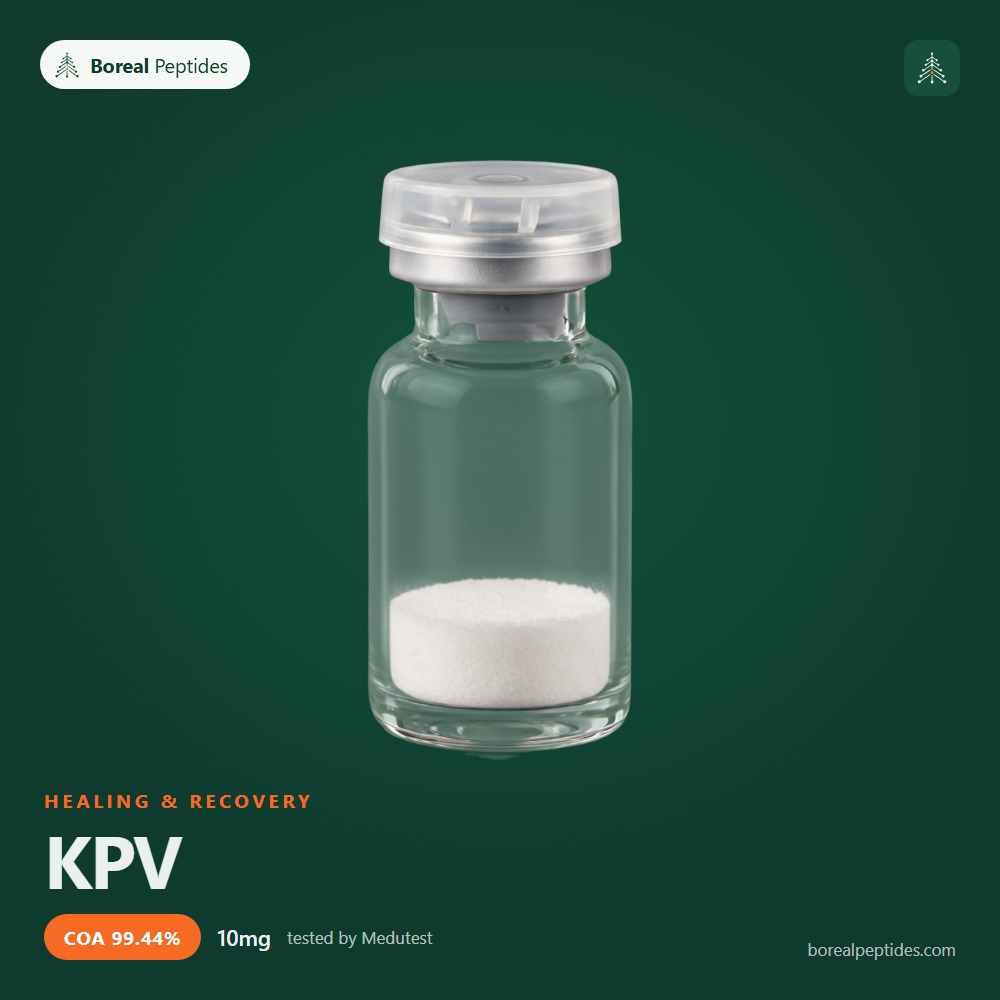
Our KPV 10mg, batch WWB-KP10-4608, was reported at 99.44% purity by HPLC from Medutest, report MT-23454, issued 21 February 2026. [5] The product page notes that this kind of test doesn’t cover sterility, endotoxin or heavy metals. [6] We list every certificate we hold on the lab results page.
How is KPV stored?
A KPV purity result describes one lot on the day it was tested. It doesn’t tell you how long the material stays stable. [5][6]
We didn’t find published stability data for KPV, so follow the label and certificate that come with your lot.
Buying KPV for research in Canada
Boreal lists KPV 10mg for laboratory research at $85 CAD. On 12 November 2026 it was in stock. The listing shows the Medutest result above and the batch number. [5][6] Orders leave West Vancouver within 1 to 2 business days and arrive in 2 to 4 business days, and shipping is free at $299 or more. [17]
KPV is also one of the four compounds in KLOW (our blend). Both KLOW and GLOW (our other blend) were out of stock on 12 November 2026, so the single KPV 10mg vial is the one we can ship now. See our healing peptides research guide for related compounds, or return to the Boreal Peptides homepage.
Ready to order?
Shipped from West Vancouver across Canada. Every result we hold is on the lab results page.
A tripeptide of lysine, proline and valine, and the C-terminal sequence of alpha-melanocyte stimulating hormone.
For laboratory research use only. Not for human or veterinary use.
People also ask
What is KPV peptide used for?
KPV is used in laboratory research. Most studies are in cell cultures and mouse colitis models, where researchers measure inflammation signals. It isn’t an approved medicine for any use in Canada or the United States. [1][2][9][12]
Read more: What does the research on KPV show?
What does KPV peptide do?
In published studies, KPV lowered NF-kB and MAP kinase activity and cytokine release in cultured human gut and T cells. In mouse colitis models, researchers reported milder colon inflammation. These are lab and animal findings, not results in people. [1][2]
Read more: How does KPV work in studies?
Is KPV FDA approved?
No. Drugs@FDA has no KPV entry as of 12 November 2026. FDA staff proposed against adding KPV to the 503A bulks list, and a July 2026 advisory vote in favour isn’t a final decision. [8][12][15]
Read more: What does Health Canada say about KPV?
Does Health Canada name KPV as an unauthorized peptide?
Yes. Health Canada’s April 2026 advisory names KPV and says a research-use-only label doesn’t make a product legal or exempt from regulatory requirements, and it has no Drug Product Database entry for KPV. Check the current notice before relying on this. [9][11]
Read more: What does Health Canada say about KPV?
Has KPV been tested in humans?
No. We found no registered human study when we searched ClinicalTrials.gov on 12 November 2026. The published work we found is in cells and animals. No safety profile has been established. [1][2][10]
Read more: What does the research on KPV show?
Is KPV the same as alpha-MSH?
No. KPV is the last three of alpha-MSH’s 13 amino acids. It leaves out positions 1 to 10, and some mouse colitis effects didn’t depend on the MC1 receptor. [2][3][4]
Read more: How is KPV related to alpha-MSH?
Sources and methodology
We searched PubMed through Europe PMC (Europe PubMed Central), PubChem, Health Canada, openFDA, FDA’s advisory committee papers, ClinicalTrials.gov and the WADA 2026 list on 12 November 2026. We opened each source for this guide. We report what each study measured and don’t give advice on use. Boreal’s own figures come from the KPV product page and the lab results page, checked the same day.
Research use only
For laboratory research use only. Not for human or veterinary use. Nothing here is medical advice.
How this guide was made: we researched and drafted it with AI assistance. We then checked every claim against its cited source, and the owner of Boreal Peptides reviewed it before publication.
Sources
- Dalmasso G, Charrier-Hisamuddin L, Nguyen HT, Yan Y, Sitaraman S, Merlin D. PepT1-mediated tripeptide KPV uptake reduces intestinal inflammation. Gastroenterology. 2008;134(1):166-178. https://pmc.ncbi.nlm.nih.gov/articles/PMC2431115/
- Kannengiesser K, Maaser C, Heidemann J, et al. Melanocortin-derived tripeptide KPV has anti-inflammatory potential in murine models of inflammatory bowel disease. Inflammatory Bowel Diseases. 2008;14(3):324-331. PMID 18092346. https://europepmc.org/article/MED/18092346
- Hiltz ME, Lipton JM. Antiinflammatory activity of a COOH-terminal fragment of the neuropeptide alpha-MSH. FASEB Journal. 1989. PMID 2550304. https://europepmc.org/article/MED/2550304
- Richards DB, Lipton JM. Effect of alpha-MSH 11-13 (lysine-proline-valine) on fever in the rabbit. Peptides. 1984. PMID 6333677. https://europepmc.org/article/MED/6333677
- Boreal Peptides. Lab results register, KPV entry: 99.44%, Medutest, report MT-23454, batch WWB-KP10-4608, 21 February 2026. Checked 12 November 2026. https://borealpeptides.com/lab-results/
- Boreal Peptides. KPV 10mg product page: price, stock, shipping, tested result and batch. Checked 12 November 2026. https://borealpeptides.com/kpv/
- PubChem. Compound summary for CID 125672 (Lys-Pro-Val, alpha-MSH 11-13). Checked 12 November 2026. https://pubchem.ncbi.nlm.nih.gov/compound/125672
- US Food and Drug Administration. FDA Briefing Document, Pharmacy Compounding Advisory Committee, 23 to 24 July 2026. https://www.fda.gov/media/193342/download
- Health Canada. Drug Product Database, active ingredient search for “kpv” and “lysyl”, 12 November 2026. https://health-products.canada.ca/dpd-bdpp/
- ClinicalTrials.gov. API search for KPV, Lys-Pro-Val, lysyl-prolyl-valine and alpha-MSH (11-13), 12 November 2026. https://clinicaltrials.gov/
- Health Canada. Think twice before injecting peptides bought online: unauthorized products can seriously harm you. 9 April 2026. https://recalls-rappels.canada.ca/en/alert-recall/think-twice-injecting-peptides-bought-online-unauthorized-products-can-seriously-harm
- openFDA. Drugs@FDA API, search by active ingredient name, 12 November 2026. https://open.fda.gov/apis/drug/drugsfda/
- Catania A, Lonati C, Sordi A, Carlin A, Leonardi P, Gatti S. The melanocortin system in control of inflammation. The Scientific World Journal. 2010. https://pmc.ncbi.nlm.nih.gov/articles/PMC5763663/
- Frier Levitt. FDA to remove 12 popular peptides from the Category 2 “Do Not Compound” list. April 2026. https://www.frierlevitt.com/articles/fda-peptides-do-not-compound-list-update-2026/
- Kelley Drye. FDA advisory committee recommends several peptides for compounding despite staff opposition. 30 July 2026. https://www.kelleydrye.com/viewpoints/blogs/ad-law-access/fda-advisory-committee-recommends-several-peptides-for-compounding-for-various-uses-despite-staff-opposition-what-stakeholders-need-to-know
- World Anti-Doping Agency. Prohibited List 2026, section S0 Non-approved substances. https://www.wada-ama.org/en/prohibited-list
- Boreal Peptides. Shipping and delivery, checked 12 November 2026. https://borealpeptides.com/shipping-and-delivery/