



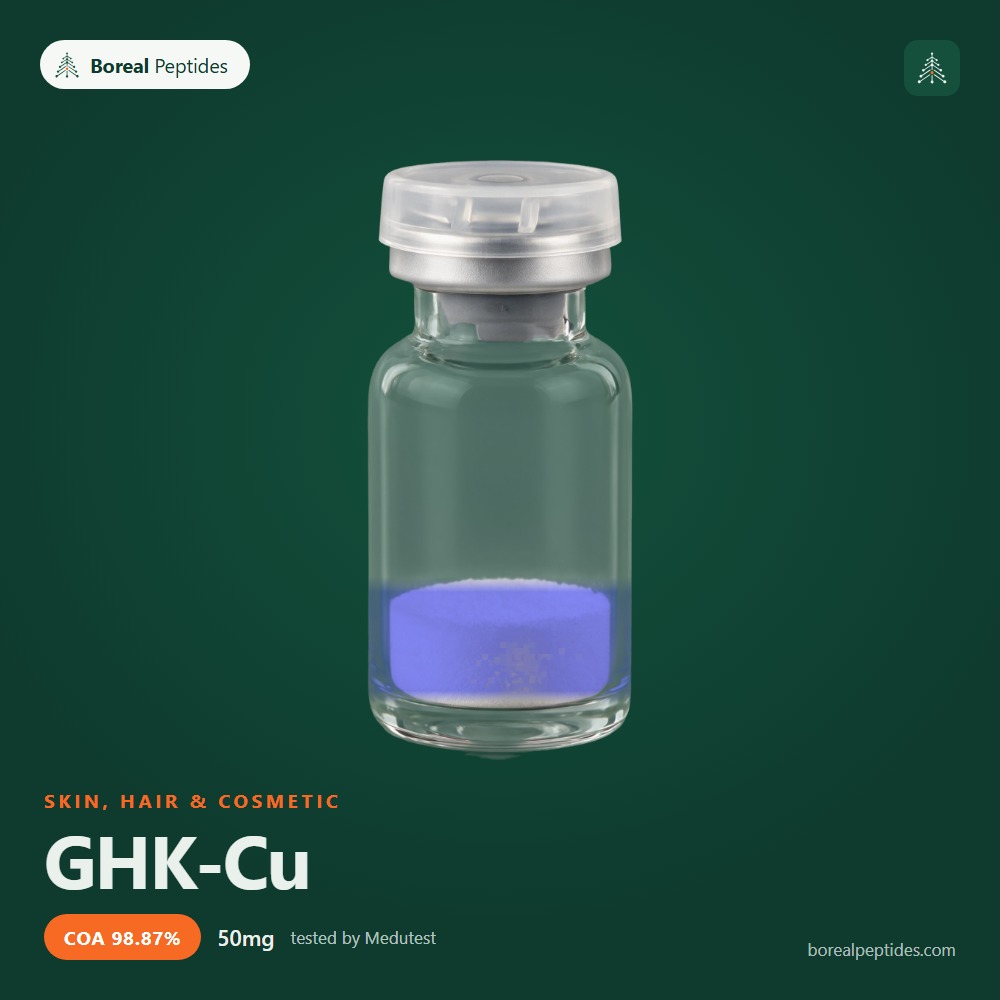
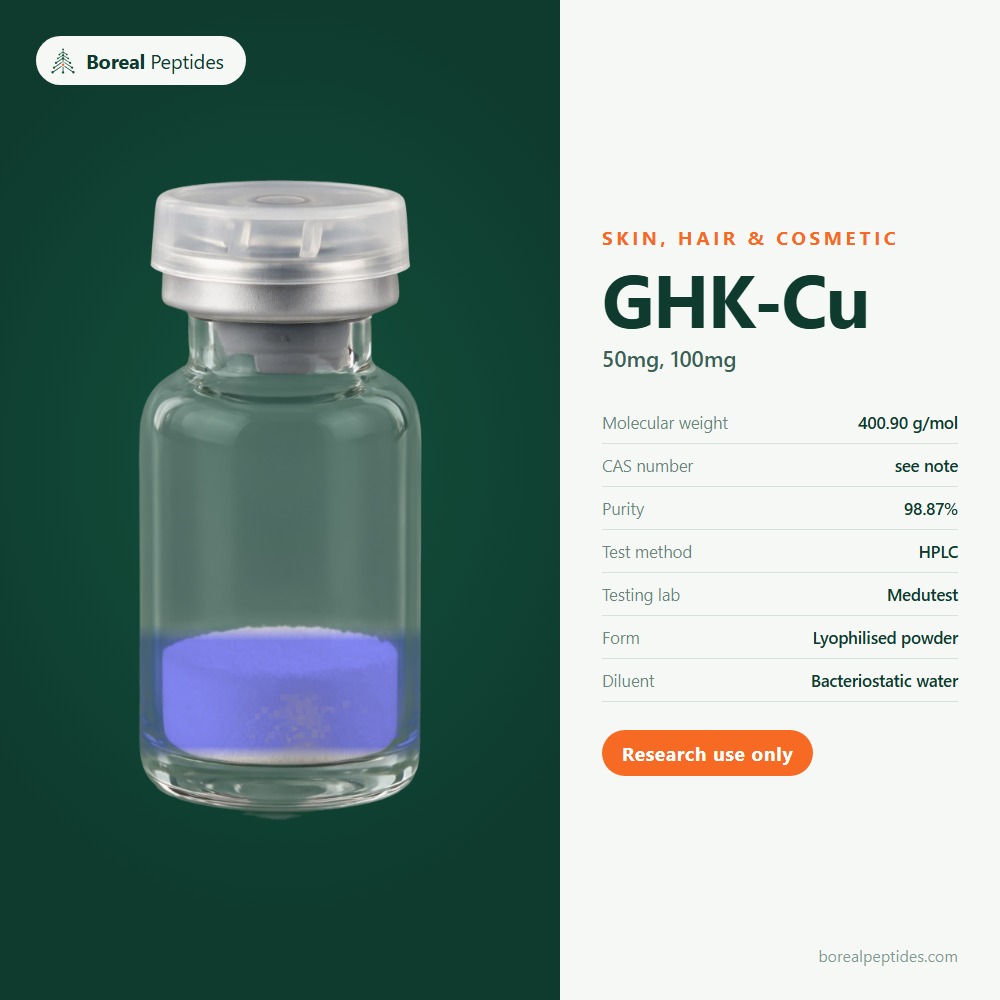


GHK-Cu (Copper Peptide) 100mg
$75.00
GHK-Cu is a naturally occurring copper-binding tripeptide, glycyl-histidyl-lysine. Third-party assayed at 98.87%, certificate on file. Available in 50mg and 100mg.
9 in stock
What GHK-Cu is
GHK is a tripeptide with the amino acid sequence glycyl-histidyl-lysine, and it occurs naturally in human plasma, saliva and urine.1
The copper form matters chemically, not as a marketing detail. When copper ions bind to the GHK tripeptide, the copper’s redox activity is silenced, which is how the complex delivers copper into a cell without the toxicity free copper would carry.1 It has been studied in skin regeneration and cellular pathway modulation.1
Purity, and what an HPLC figure covers on a copper complex
GHK-Cu is tested at 98.87% with Medutest.
Worth being precise on this one. For a copper complex, peptide purity and copper content are separate questions, and an HPLC purity result addresses the peptide. It does not measure sterility, endotoxin or heavy metals either.
Almost nobody in this category publishes any figure at all, so the useful comparison isn’t between our number and a competitor’s. It’s between a number and nothing.
Where else GHK-Cu appears on this site
GHK-Cu is 50mg of both KLOW, at 80mg total, and GLOW, at 70mg total. In each, GHK-Cu is the bulk of the vial rather than a supporting component.
If you want GHK-Cu specifically, the single vial gives you control over concentration. If you want it alongside BPC-157 and TB-500, the blends do that in one reconstitution, and KLOW carries a finished-blend certificate.
GHK-Cu ships Canada-wide. The packing slip carries the batch certificate reference, so the vial in your hand can be matched against the report on this page.
| Compound | GHK-Cu (Copper Peptide) |
|---|---|
| Molecular formula | C14H21CuN6O4- |
| Molecular weight | 400.90 g/mol |
| CAS number | see note |
| PubChem CID | 139035031 |
| Purity | 98.87% |
| Test method | HPLC |
| Testing lab | Medutest |
| Batch | WWB-CU100-4385 |
| What the assay does not cover | Sterility, endotoxin, heavy metals |
| Physical form | Lyophilised vial |
| Strengths available | 100mg |
| Diluent | Bacteriostatic water |
| Regulatory status, Canada | Named in Health Canada notices |
| Intended use | Laboratory research use only |
Sources cited above
- Pickart L, Vasquez-Soltero JM, Margolina A. “GHK Peptide as a Natural Modulator of Multiple Cellular Pathways in Skin Regeneration.” BioMed Research International, 2015. https://pmc.ncbi.nlm.nih.gov/articles/PMC4508379/
GHK-Cu (Copper Peptide): frequently asked questions
Direct answers on identity, testing, cost and the Canadian regulatory position. We do not publish dosing or effect claims, and one of the questions below explains why.
What is GHK-Cu?
GHK-Cu (Copper Peptide) is a research compound supplied for laboratory research use only. Its verified identity data is a molecular weight of 400.90 g/mol, PubChem CID 139035031. It is listed under Skin, Hair & Cosmetic and available in 100mg.
Is GHK-Cu safe?
No safety profile has been established for GHK-Cu (Copper Peptide), and nothing on this site should be read as saying otherwise. What we can tell you is narrower and verifiable: this lot was assayed at 98.87% by Medutest and we hold the full report and send it on request. An HPLC purity result is a statement about identity and purity in a tested lot. It does not measure sterility, endotoxin or heavy metals, and it is not a safety assessment. Health Canada has published advisories on unauthorized injectable peptides, and you should read the research use disclaimer before ordering.
Is GHK-Cu legal in Canada?
Health Canada regulates injectable peptides as drugs, and it has stated in writing that labelling one “for research use only” does not remove it from that regulation. The regulator has published advisories naming specific compounds, seized product from Canadian sellers, and obtained a court injunction against at least one seller. Most suppliers present research use labelling as though it settles the question. On the regulator’s own published statements, it does not, and we would rather say so than let you assume otherwise. Read the disclaimer in full.
Is GHK-Cu a steroid?
No. GHK-Cu (Copper Peptide) is a peptide, not an anabolic steroid, and the two are different classes of molecule with different structures. Its molecular weight is 400.90 g/mol. Steroids share a four-ring carbon skeleton; peptides are chains of amino acids.
How to reconstitute GHK-Cu?
Use the peptide calculator: enter the vial’s total mass and your target concentration, and it returns the volume of bacteriostatic water to add. That is arithmetic, not a dosing instruction, and it is the step people most often get wrong. Reconstituted material has a much shorter usable life than sealed powder.
Is GHK-Cu third party tested?
Yes. This lot was assayed at 98.87% by Medutest, and we hold the full report and send it on request rather than compressing it into a badge. The batch reference travels on the packing slip, which is what lets you match the vial you received to the report on the lab results index. A purity figure with no batch behind it tells you nothing about your vial.
Where to buy GHK-Cu in Canada?
Here, shipped across Canada, with the batch certificate reference on the packing slip. The thing worth comparing between Canadian suppliers is not price but what each one publishes: whether a third-party report exists, whether it is shown in full or reduced to a percentage, and whether it can be tied to the lot you received.
How much does GHK-Cu cost?
Prices are on the product page in Canadian dollars, and this product is offered in 100mg. Compare price per milligram rather than price per vial, because strengths differ between suppliers and a cheaper vial is often a smaller one. A vial with no assay and no batch reference is not the same product at a lower price, it is a different proposition.
What does GHK-Cu do?
We do not answer that here, and the reason is not evasiveness. Describing what a compound does, in a shop that sells it, is a therapeutic claim, and that is the line between describing a research compound and marketing an unlicensed drug. What we publish instead is identity, purity, the testing laboratory and the limits of the assay. Where published research exists, the product page cites it and links the source so you can read it yourself rather than take our summary of it.
GHK-Cu vs KLOW, which contains it?
They are different compounds with different identity data and different research literature, and neither substitutes for the other. The comparison worth making is on what each one is and what evidence exists for it, which is set out on both product pages. See KLOW, which contains it.
Related products



Reviews
Clear filtersThere are no reviews yet.