
Peptide Blends & Stacks
A blend is harder to verify than a single vial, and the reason is worth a minute of your time. A component certificate describes a raw material before it was mixed. It doesn’t describe the vial you receive.
Two of the three carry a laboratory certificate. We read both, and the identity data on each one describes a single component rather than the mixture, so we are not claiming either blend was assayed as a finished blend. The third has no certificate at all.
Nothing here is approved for human use in Canada. We publish no dosing, no protocols and no stacks.
Showing all 2 results
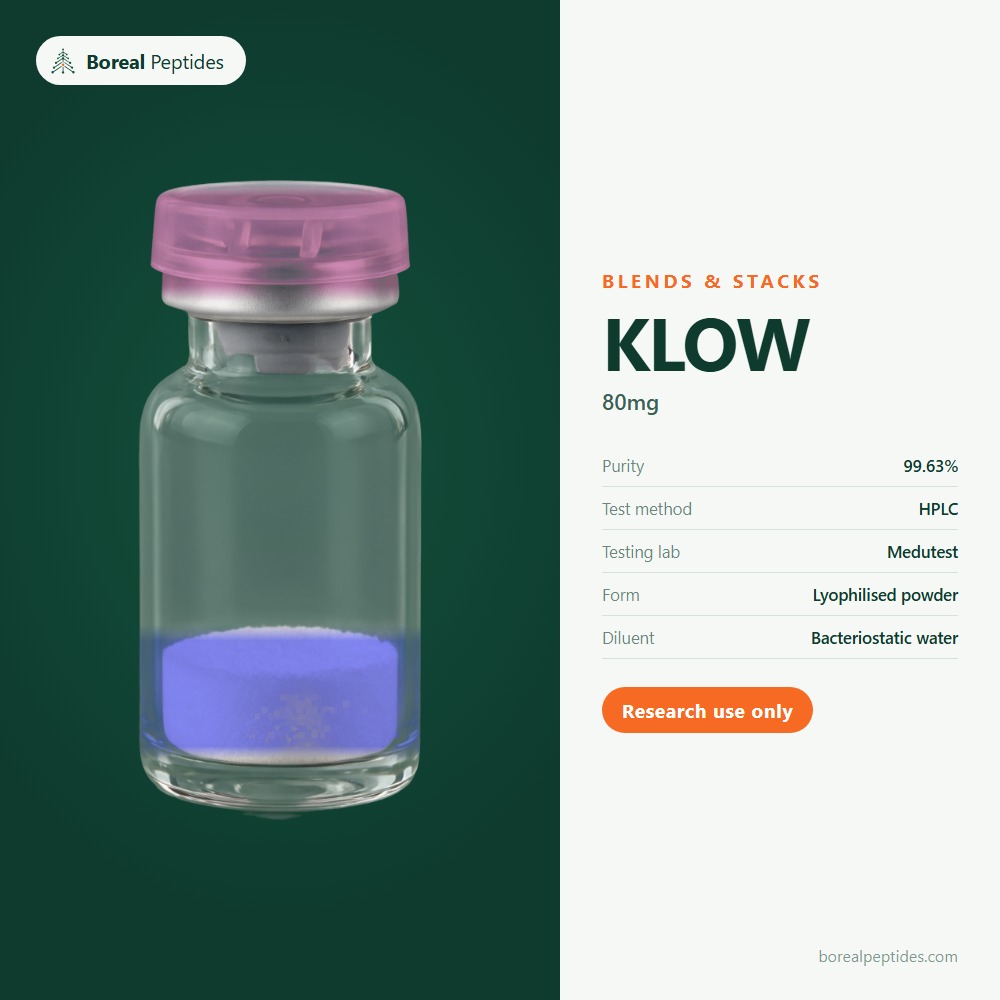
The three blends, and exactly what has been tested
| Blend | What is in the vial | Certificate | What its identity block describes |
|---|---|---|---|
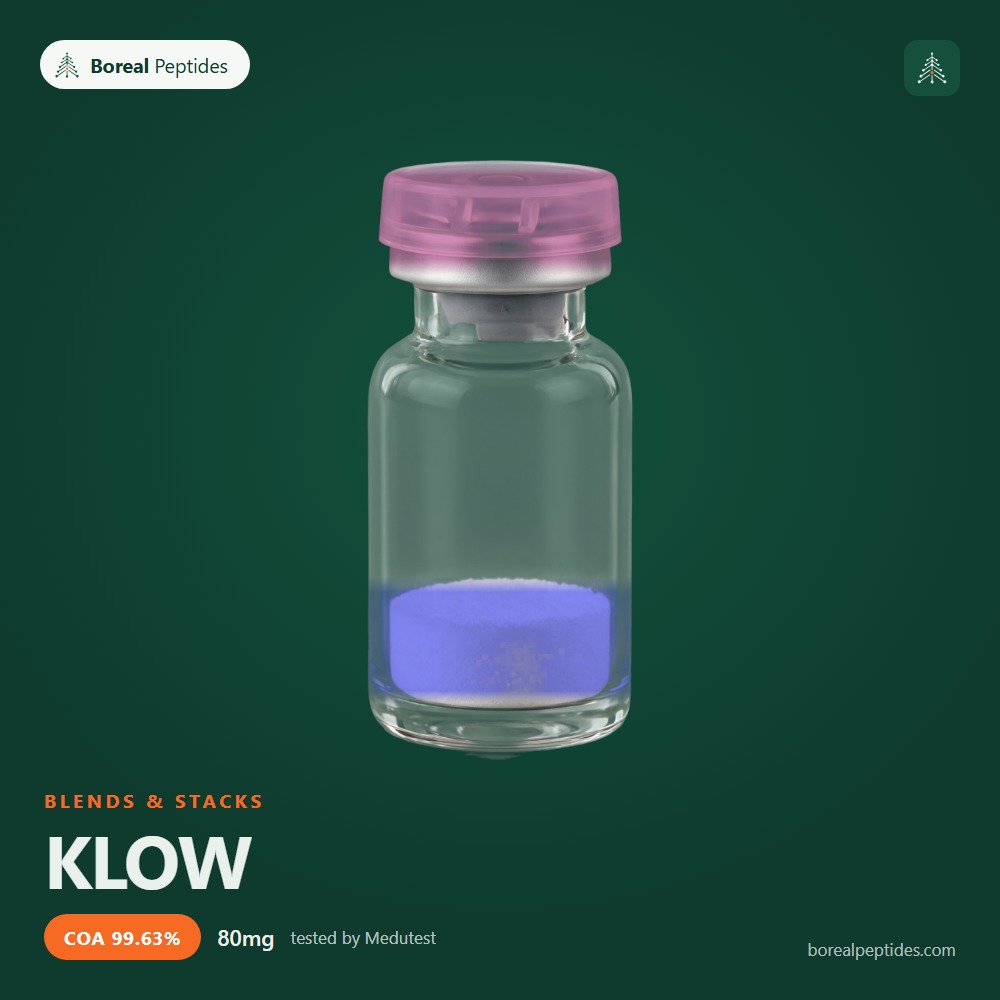
| KLOW Blend 80mg | TB-500 10mg, BPC-157 10mg, KPV 10mg, GHK-Cu 50mg | 99.63%, Medutest, batch WWB-KL80-6138 | GHK-Cu only. See below. |
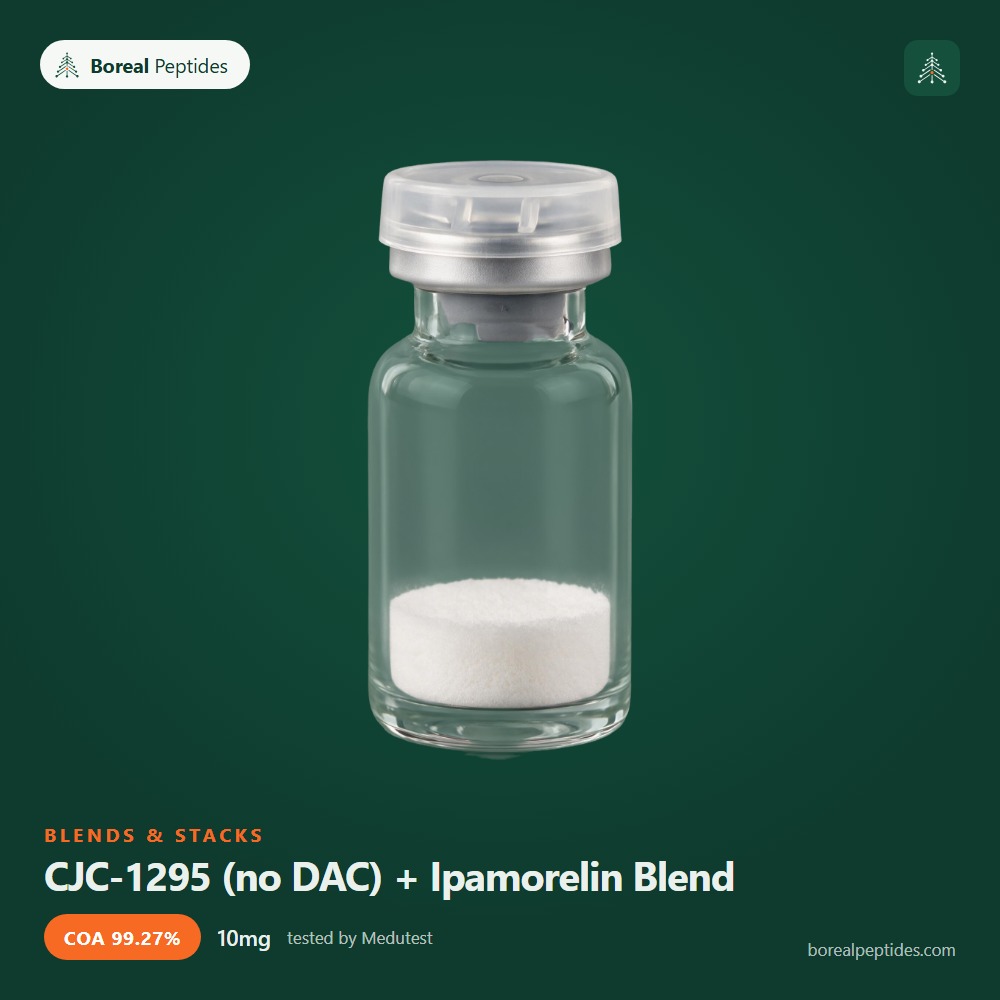
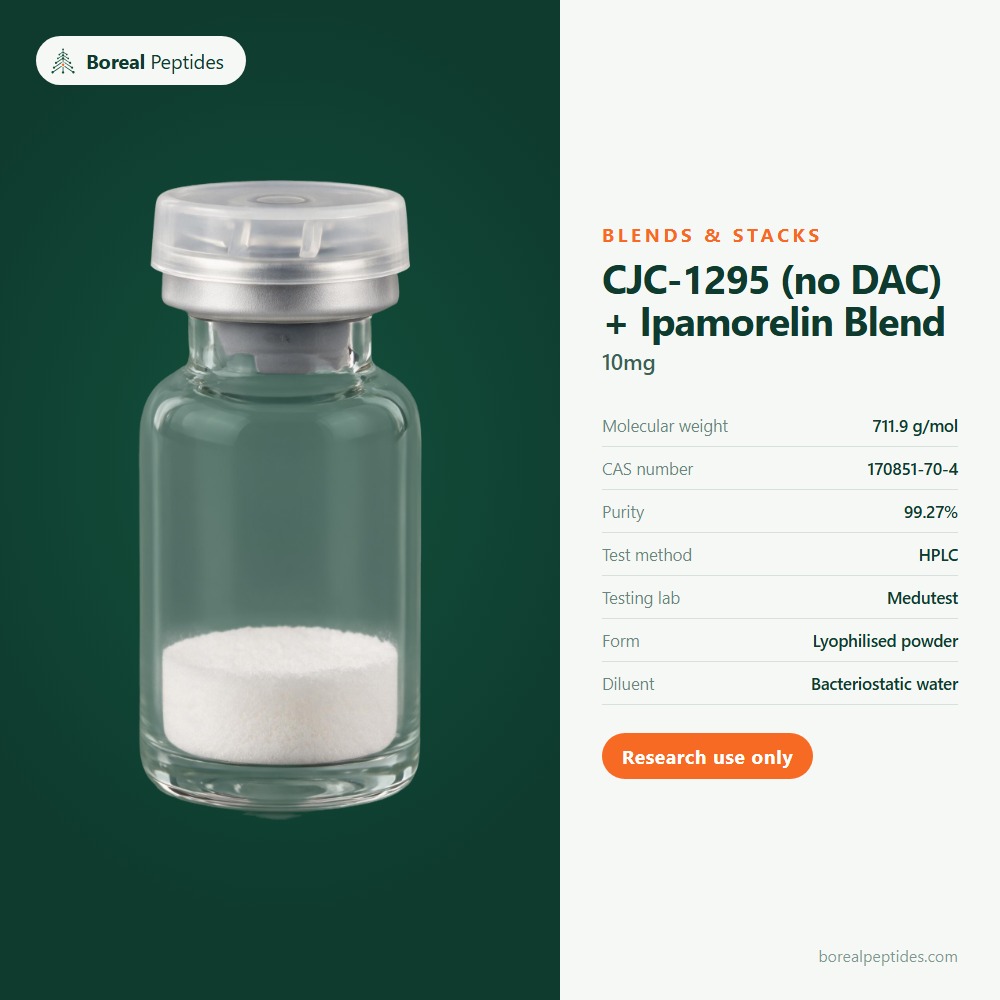
| CJC-1295 Ipamorelin | CJC-1295 without DAC 5mg, Ipamorelin 5mg | 99.27%, Medutest, batch WWB-CP10-8748 | CJC-1295 only. See below. |
| GLOW Blend 70mg | BPC-157 10mg, GHK-Cu 50mg, TB-500 10mg | None | n/a |
Every figure above came from HPLC. An HPLC purity result covers identity and purity of the material in the vial at the stated total mass. It does not measure sterility, endotoxin or heavy metals, and it describes that lot rather than everything sharing a label. We hold each report and send it on request.
We read our own certificates, and two of them do not add up
This section used to make a stronger claim than the paperwork supports. We are replacing it with what the documents actually say, because you should be able to see the same thing we did.
The KLOW certificate is titled with all four compounds and reports 99.63%. Its identity block reads CAS 49557-75-7, molecular weight 403.93 Da, formula C6H4CuN4O4, appearance "blue lyophilised powder", and a mass spectrometry line confirming a single species at 403.70.
Those are GHK-Cu's identity fields, character for character. They are identical to the ones on our separate GHK-Cu certificate. A four-compound 80mg blend cannot have one CAS number, one molecular weight of 403.93 Da, or a single species on the mass spec.
The CJC-1295 Ipamorelin certificate has the same shape of problem. It records CAS 863288-34-0 and 3,367.97 Da, which is CJC-1295 without DAC on its own. Ipamorelin is 711.9 g/mol and does not appear.
So what can we honestly say? A laboratory issued a certificate titled with the blend and reported a purity figure. What its identity data characterises is one component, not the mixture. We have asked Medutest to clarify what was analysed, and until they answer, this page will not tell you these blends were assayed as finished blends.
Why this matters more than the number
A component certificate describes a raw material before anyone combined anything. The sample the laboratory tested was not the product you opened. That is a real problem with how blends are verified across this market, and it is the reason the distinction is worth understanding at all.
What we cannot do is claim to have solved it when our own paperwork does not show that we have. GLOW carries no figure because it has no certificate. KLOW and the CJC-1295 blend carry figures whose scope is unclear. Those are three different states and this page now shows all three.
KLOW is not four equal parts
Worth knowing before you work out concentrations. KLOW is 80mg total, but GHK-Cu is 50mg of the 80mg. TB-500, BPC-157 and KPV are 10mg each. If you were picturing a balanced four-way split, it isn't one.
GLOW is 70mg on the same pattern: GHK-Cu 50mg, BPC-157 10mg, TB-500 10mg. The copper complex is what gives that powder its blue colour.
The only difference between GLOW and KLOW is KPV. Same three other compounds, same masses. So if a document matters to you, KLOW has one, with the caveat above. If your model specifically excludes KPV, GLOW is the closer match and an assay for it is the next one we're paying for.
CJC-1295 without DAC is not sermorelin, and not CJC-1295 with DAC
Three different molecules get sold under overlapping names, which makes them easy to confuse when you're comparing blends.
The no-DAC form is also called Modified GRF 1-29. Our certificate records CAS 863288-34-0 and a molecular weight of 3367.97 Da for that component, which is the correct compound. Sermorelin and the DAC form have different CAS numbers and different molecular weights. If a supplier prints sermorelin's identity data on a CJC-1295 page, that tells you how carefully the rest of the listing was written.
The pairing itself has a reason behind it. CJC-1295 without DAC is a growth hormone releasing hormone analogue.1 Ipamorelin acts on a different receptor, as a ghrelin mimetic, and has been studied in a rodent model of gastric dysmotility.2 They're paired in research because they act differently, not because they're alternatives to each other. Neither citation is a finding about people.
Regulatory status in Canada
Health Canada regulates injectable peptides as drugs and has stated in writing that labelling one "for research use only" doesn't remove it from that regulation.3 Every blend on this page is supplied for laboratory research use only, and nothing here is approved for human or veterinary use.
We publish no dosing, no protocols and no stacks. A blend is a convenience of packaging on this site, not a recommended combination.
Buying peptide blends in Canada
All three ship as single lyophilised vials, anywhere in Canada, and all three are in stock. KLOW is 80mg total, GLOW is 70mg, and CJC-1295 Ipamorelin is 10mg total. Each is reconstituted with bacteriostatic water, which we stock separately.
Every component of KLOW and GLOW is also sold as a single vial. BPC-157, TB-500 and KPV sit in healing and recovery research peptides, and GHK-Cu sits in skin, hair and cosmetic research peptides. Buying separately gives you control over the ratio. Buying a blend gives you one reconstitution instead of three or four, and in two cases a certificate for the actual vial.
Compare on price per milligram rather than price per vial. When you order, the batch reference travels on the packing slip, so the report we hold is the report for the vial you open.
Browse the full range, or contact us with a blend name to ask for a certificate before you buy.
Common questions
What is a peptide stack? In this catalogue it means several compounds supplied in one vial rather than several. It isn't a protocol and it isn't a recommendation. We don't publish stacks in the sense of "take these together", and a blend on this page is a packaging choice, nothing more.
What's the difference between GLOW and KLOW? KPV. KLOW is GLOW's three compounds plus KPV 10mg, at 80mg total instead of 70mg. KLOW also has a finished-blend certificate and GLOW doesn't yet.
Why does GLOW have no purity figure? Because it has no certificate of its own. Its three components each have one as single vials, but those describe raw materials, not this vial. We'd rather show you a blank than a number that answers a different question.
Which blends have a certificate of analysis? Two of three. KLOW at 99.63% and CJC-1295 Ipamorelin at 99.27%, both with Medutest, both with the batch named. Read the section above before you weigh those figures: the identity data on both describes a single component, not the blend.
Are peptide blends safe? No safety profile has been established for any compound in these blends, and a purity assay isn't a safety assessment. An HPLC figure covers identity and purity in one lot. It doesn't measure sterility, endotoxin or heavy metals.
Are they legal in Canada? Health Canada regulates injectable peptides as drugs, and research use labelling doesn't change that. Nothing here is approved for use in a person, we won't supply dosing, and buying a vial doesn't make its use lawful.
How long does reconstituted material last? Much less time than sealed lyophilised powder. Reconstitution shortens the usable life considerably, which is why the vials ship as dry powder rather than in solution.
Sources
- Knoop A, Thomas A, Fichant E, Delahaut P, Schänzer W, Thevis M. "Qualitative identification of growth hormone-releasing hormones in human plasma by means of immunoaffinity purification and LC-HRMS/MS." Analytical and Bioanalytical Chemistry, 2016. doi:10.1007/s00216-016-9377-3. https://pubmed.ncbi.nlm.nih.gov/26879649/
- Greenwood-Van Meerveld B et al. "Efficacy of ipamorelin, a ghrelin mimetic, on gastric dysmotility in a rodent model of postoperative ileus." Journal of Experimental Pharmacology, 2012. doi:10.2147/jep.s35396. https://pubmed.ncbi.nlm.nih.gov/27186127/
- Health Canada. "Think twice before injecting peptides bought online: unauthorized products can seriously harm your health." Advisory, 9 April 2026: "This type of labelling does not make these products legal or exempt from regulatory requirements." https://recalls-rappels.canada.ca/en/alert-recall/think-twice-injecting-peptides-bought-online-unauthorized-products-can-seriously-harm